





What's Happening?
Radiant, an El Segundo, California-based company, is actively seeking a Principal Nuclear Engineer specializing in Sensors & Instrumentation for its Kaleidos microreactor project. The company aims to mass-produce transportable nuclear microreactors to address
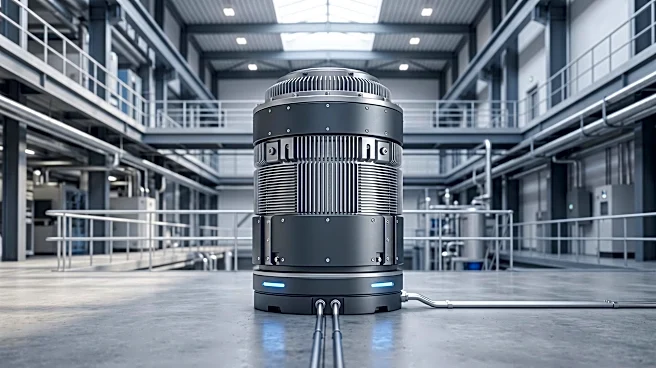
the growing strain on the U.S. grid, rising utility costs, and increasing carbon emissions. Radiant's Kaleidos microreactor is designed to be a 1-megawatt unit, capable of powering 1,000 homes for five years, and is small enough for factory construction and transport by land, sea, or air. The company has secured contracts to supply power to the U.S. Army, Navy, and Air Force, and has pre-order agreements with Equinix, with deployments scheduled to begin in 2028. The Principal Nuclear Engineer will be responsible for leading the technical direction for sensor and instrumentation solutions, including radiation detection, neutron flux monitoring, and environmental qualification for high-temperature, high-radiation environments.
Why It's Important?
Radiant's development of transportable microreactors represents a significant advancement in addressing critical energy needs across various sectors in the U.S. The ability to deploy 1-megawatt reactors on-site for military bases, data centers, hospitals, and remote locations offers a decentralized and resilient power solution, reducing reliance on the strained national grid. This initiative could enhance national security by providing reliable power to critical infrastructure and contribute to carbon emission reduction goals. The recruitment of a Principal Nuclear Engineer underscores the complex technical challenges involved in bringing such advanced nuclear technology to fruition, particularly in ensuring the safety and performance of reactor instrumentation under extreme conditions. The success of Kaleidos could set a precedent for future microreactor deployments and influence U.S. energy policy towards smaller, more flexible nuclear power options.
What's Next?
Radiant's immediate next step is to fill the critical Principal Nuclear Engineer position to advance the development and qualification of its Kaleidos microreactor's sensor and instrumentation systems. With deployments slated for 2028, the company will focus on rigorous testing and regulatory approvals to ensure the safe and efficient operation of its microreactors. The successful deployment of these units for the U.S. military and Equinix will be a key indicator of the technology's viability and market acceptance. Future developments will likely include scaling up production, expanding customer agreements, and potentially influencing broader energy infrastructure planning in the U.S. as the demand for reliable, on-site power continues to grow.
Beyond the Headlines
The emergence of companies like Radiant, focusing on mass-produced, transportable microreactors, signals a potential paradigm shift in how nuclear energy is perceived and utilized. This approach moves away from large, centralized power plants towards smaller, more adaptable units that can be deployed where power is most needed, potentially democratizing access to nuclear energy. The emphasis on 'transportable' and 'on-site' power also highlights a strategic shift towards energy resilience and independence, particularly for critical infrastructure. However, the regulatory framework for such novel nuclear technologies will need to evolve, and public acceptance will be crucial. The success of Kaleidos could pave the way for a new era of nuclear power, but it also raises questions about waste management, security, and the long-term environmental impact of widespread microreactor deployment.