




What's Happening?
Genesis AI has successfully raised $500 million in a Series A funding round, achieving a $3.5 billion post-money valuation. This significant investment was co-led by Premji Invest, Khosla Ventures, and Eclipse, with additional backing from prominent entities
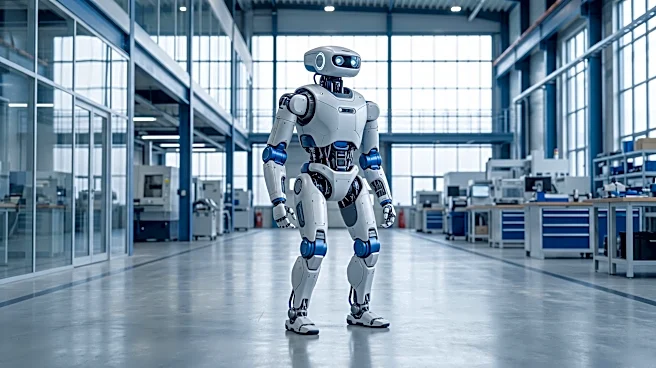
including NVIDIA, AMD Ventures, Samsung Next, Zoom, former Google CEO Eric Schmidt, Zoom CEO Eric Yuan, Yahoo co-founder Jerry Yang, and T. Rowe Price-advised accounts. The company plans to utilize these funds to expand its robot training programs, enhance its artificial intelligence capabilities, increase the production of its general-purpose robot, Eno, and hire more researchers and robotics engineers. Genesis AI aims to begin deploying Eno robots at customer sites in 2027, starting with industrial workplaces. The company's robots are designed to learn physical tasks from human demonstrations rather than relying on pre-programmed movements, with a mission to remove physical limits on human ambition, as stated by co-founder and CEO Zhou Xian.
Why It's Important?
This substantial investment in Genesis AI signifies a major leap forward in the development and deployment of AI-powered robots in the workplace. The $500 million funding round, backed by a diverse group of influential investors and tech leaders, validates the potential of Genesis AI's approach to robotics, which emphasizes learning from human demonstrations. This method could revolutionize various industries by enabling robots to adapt to changing conditions and handle complex workflows, moving beyond repetitive, single-task operations. The initial focus on manufacturing, logistics, and laboratories suggests a direct impact on efficiency, safety, and productivity in these sectors. The involvement of major tech companies and investment firms highlights a broader industry trend towards integrating advanced AI and robotics into core business operations, potentially leading to significant economic shifts and new job opportunities in robotics and AI development.
What's Next?
Genesis AI plans to initiate the deployment of its Eno robots at customer sites in 2027, with initial focus areas including manufacturing facilities, logistics operations, and laboratories. The company has already begun proof-of-concept projects and customer pilots in 2026. A strategic partnership with LG CNS is in place to evaluate the robots for manufacturing and logistics work at LG operations in the United States. The funding will be crucial for expanding robot training, improving AI, and scaling up Eno production. Genesis AI also intends to expand into hospitality and healthcare sectors after its industrial deployments, with home robots and outdoor applications further down its development roadmap. A key challenge for the company will be ensuring the robots operate reliably and safely in real-world environments, moving beyond controlled demonstrations.
Beyond the Headlines
The rise of general-purpose AI robots like Eno, capable of learning from human demonstrations, presents profound implications for the future of work and society. While Genesis AI aims to remove physical limits on human ambition, the long-term effects on employment remain a significant consideration. The company's data collection methods, involving electronic gloves and head-mounted cameras, raise questions about data ownership and privacy, even though Genesis states participation is voluntary and no personally identifying information is captured. The ability of these robots to adapt and handle entire workflows could lead to a redefinition of human roles in various industries, potentially creating new demands for skills in robot supervision, maintenance, and AI development. This technological advancement could also spark ethical debates about the integration of AI into daily life and the balance between automation and human labor.