




What's Happening?
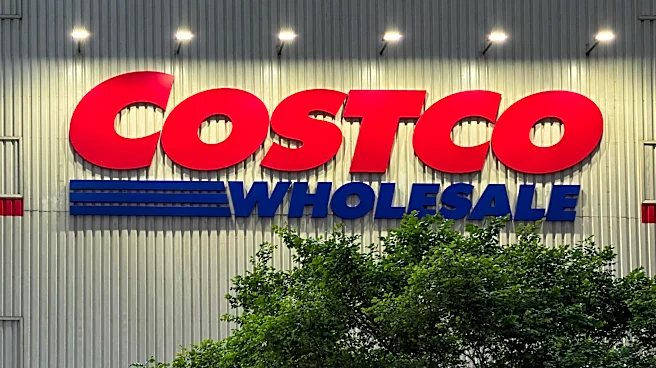
Costco Wholesale (COST) has announced a special cash dividend of US$30 per share, totaling a US$13.3 billion payout scheduled for early December. This declaration follows a period of strong stock performance for the company, with its share price increasing
by 9.4% over the past month and 14.8% over the past quarter. The total shareholder return for Costco Wholesale stands at 27% over one year and nearly 98% across three years. Despite this positive momentum and the generous payout, some investors, as highlighted by a narrative on Simply Wall St, suggest that Costco Wholesale could be 27% overvalued. The stock closed at $1,097.91, while the perceived fair value is $861.94, according to community investor LunaRodas. The company's core-on-core margins have also shown strength, increasing by 18 basis points in the fourth quarter, attributed to supply chain efficiencies and improved labor productivity in various departments.
Why It's Important?
The declaration of a significant special dividend by Costco Wholesale signals a strong financial position and a commitment to returning capital to shareholders. This move can attract investors seeking immediate returns and may further boost investor confidence in the company's profitability and cash generation capabilities. However, the debate surrounding the stock's potential overvaluation introduces a critical element of risk for investors. If the market corrects to align with the lower fair value assessment, shareholders could experience a decline in their investment, even after receiving the dividend. The company's ability to improve core-on-core margins through supply chain efficiencies and labor productivity is crucial for long-term sustainability and profitability, especially in a competitive retail landscape. This financial maneuver by Costco could influence other retailers to consider similar strategies for cash returns, impacting broader market trends in the retail sector.
What's Next?
Investors will be closely watching the market's reaction to the special dividend payout in early December, as well as any subsequent movements in Costco Wholesale's stock price. The company's ongoing expansion plans and any further announcements regarding buybacks or board changes will also be key factors influencing its future trajectory. The narrative of potential overvaluation suggests that some investors may re-evaluate their positions, potentially leading to increased volatility in the stock. Furthermore, the sustainability of Costco's margin improvements, driven by supply chain efficiencies and labor productivity, will be a critical area of focus for analysts and investors. The company will need to demonstrate continued operational excellence to justify its current valuation and maintain investor confidence, especially if membership growth rates begin to slow.
Beyond the Headlines
The decision by Costco Wholesale to issue a substantial special dividend, while seemingly a positive for shareholders, also raises deeper questions about corporate financial strategy and market valuation. The divergence between the stock's current trading price and its perceived fair value highlights the complexities of market sentiment versus fundamental analysis. This situation could prompt a broader discussion within the investment community about the sustainability of high valuations in the retail sector, particularly for companies that have experienced significant growth. The emphasis on supply chain efficiencies and labor productivity as drivers of margin improvement underscores a shift towards operational optimization in the face of evolving economic conditions. This focus on internal efficiencies, rather than solely relying on market expansion, could become a benchmark for other large retailers navigating similar challenges.