






What's Happening?
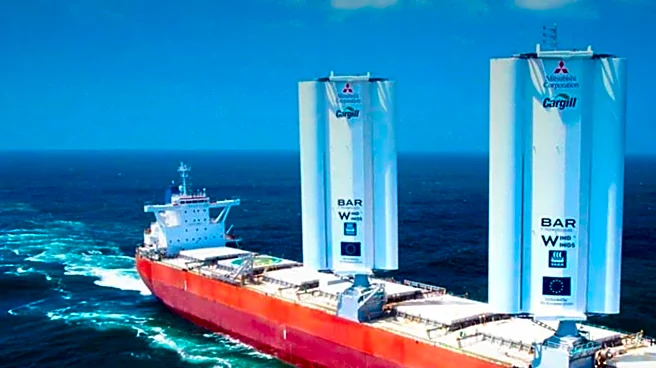
LD Armateurs and Norsepower have completed the installation of six rotor sails on the 'Spirit of Toulouse,' the first of three low-emission RoRo vessels designed to transport aircraft components for Airbus between Europe and North America. The installation,
carried out by Wuchang Shipbuilding Industry Group in Shanghai, makes the 'Spirit of Toulouse' the world's largest RoRo vessel equipped with wind-assisted propulsion and the vessel carrying the highest number of mechanical sails. Each Norsepower Rotor Sail is 35 meters high and five meters in diameter. This wind propulsion system complements two dual-fuel main engines and two dual-fuel generator sets capable of operating on e-methanol, bio-methanol, or marine diesel oil. This combined propulsion arrangement aims to reduce fuel consumption and emissions during transatlantic voyages.
Why It's Important?
This development is significant for the shipping industry, particularly in the context of reducing carbon emissions and achieving sustainability goals. The 'Spirit of Toulouse' represents a major step forward in integrating wind-assisted propulsion with dual-fuel engine technology on a large scale. For U.S. industries, especially those involved in logistics and manufacturing with transatlantic supply chains, this vessel signifies a move towards more environmentally friendly transportation options. Airbus, as the charterer, demonstrates a commitment to reducing its carbon footprint in its supply chain, which could set a precedent for other major manufacturers. The successful implementation and operation of this technology could accelerate the adoption of similar hybrid propulsion systems across the global shipping fleet, impacting fuel markets and maritime engineering sectors.
What's Next?
Following the completion of rotor sail installation, the 'Spirit of Toulouse' will undergo sea trials to validate the performance of the wind propulsion system and its integration with the onboard propulsion equipment. Further optimization is planned during its maiden voyage from China to France. The remaining two vessels in the series, 'Spirit of Mobile' and 'Spirit of Mirabel,' are also scheduled to receive Norsepower rotor sails. The operational data and efficiency gains from these vessels will be crucial in demonstrating the commercial viability and environmental benefits of such advanced propulsion systems. This could lead to increased demand for wind-assisted technologies and dual-fuel engines in new ship builds and retrofits across the maritime industry.
Beyond the Headlines
The deployment of six rotor sails on a vessel of this size highlights a broader shift in maritime engineering towards innovative solutions for decarbonization. This project showcases the potential for combining multiple green technologies to achieve significant reductions in emissions, moving beyond single-solution approaches. Ethically, it underscores the growing pressure on global industries to adopt sustainable practices throughout their supply chains, driven by regulatory demands and consumer expectations. Legally, the success of such vessels could influence future international maritime regulations regarding emissions standards and propulsion system requirements. Culturally, it represents a return to harnessing natural forces like wind for propulsion, albeit with modern technological advancements, signaling a blend of traditional seafaring with cutting-edge engineering in the quest for a greener future.