



What's Happening?
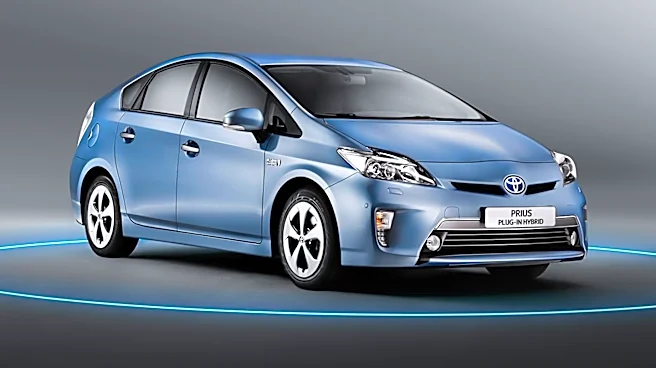
New data released by the EU indicates that carbon dioxide emissions from plug-in hybrid (PHEV) cars are, on average, six times higher than what official tests suggest. This discrepancy between real-world CO2 pollution and lab-based test results has reportedly
widened annually since real-world emission measurements began in 2021. Transport & Environment (T&E) reports that real-world PHEV emissions averaged 145g of CO2 per km in 2024, significantly higher than the official test result of 24g per km. This represents a 5% increase in real-world emissions from 2023 to 2024, despite official tests showing a 15% decrease in claimed emissions during the same period. PHEVs, which combine an electric battery with a petrol or diesel engine, currently constitute 9.8% of EU car sales. The car lobby is reportedly pushing to cancel a planned 2027 regulatory update designed to close this gap.
Why It's Important?
This revelation has significant implications for environmental policy, consumer trust, and the automotive industry, particularly in the U.S. While the data originates from the EU, it highlights a potential global issue with PHEV emissions that could influence regulatory approaches and consumer perceptions in the U.S. If U.S. testing methodologies for PHEVs similarly underestimate real-world emissions, it could undermine climate goals and lead to a false sense of progress in reducing transportation-related pollution. Consumers who purchase PHEVs expecting significant environmental benefits and fuel savings may be misled, leading to higher fuel costs and a larger carbon footprint than anticipated. For the automotive industry, this data could intensify pressure to develop truly low-emission vehicles and could lead to stricter regulations on how PHEVs are marketed and tested, potentially accelerating the transition to fully electric vehicles in the U.S. market.
What's Next?
The EU is scheduled to update 'utility factors' in 2025 and 2027 to more accurately reflect real-world CO2 ratings for PHEVs. However, the car lobby is actively campaigning against these updates. The EU Council is expected to debate the revision of car CO2 standards on October 12, with a vote in the EU Parliament anticipated in November. Should the EU proceed with stricter regulations, it could set a precedent that influences U.S. environmental agencies and policymakers to re-evaluate their own testing protocols and emission standards for PHEVs. Automakers operating in both markets may face increased pressure to innovate and produce PHEVs that genuinely deliver on their environmental promises, or to shift focus more rapidly towards fully electric vehicles. Consumers in the U.S. might see increased scrutiny of PHEV claims and potentially new incentives or disincentives related to their purchase.
Beyond the Headlines
The discrepancy between official and real-world PHEV emissions points to a deeper issue of 'greenwashing' within the automotive industry, where products are marketed as environmentally friendly without fully delivering on those claims. This situation echoes past controversies, such as 'Dieselgate,' where manufacturers manipulated testing to meet emission standards. The reliance on 'utility factors' that don't reflect actual driving behavior highlights a systemic flaw in regulatory frameworks that can be exploited by industry. This could lead to a broader re-evaluation of how environmental performance is measured and regulated across various industries, not just automotive. Ethically, it raises questions about corporate responsibility and transparency, and the potential for consumer deception. The long-term impact could be a significant erosion of public trust in environmental certifications and a stronger demand for independent, real-world testing to ensure that environmental claims are verifiable and meaningful.