


What's Happening?
Rivian CEO RJ Scaringe is expanding the company's focus beyond electric vehicle production to include autonomous driving technology, proprietary custom vehicle chips, and an independent robotics company called Mind Robotics. This multi-faceted approach
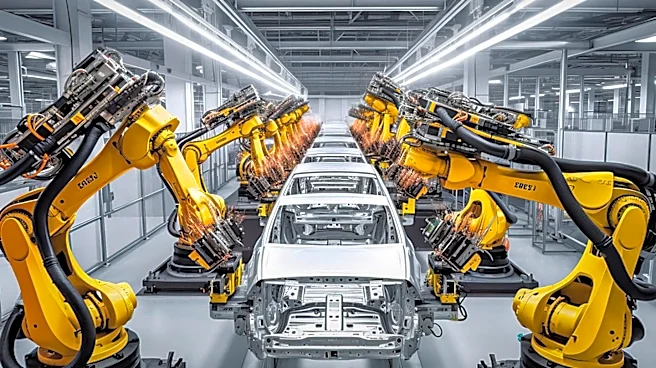
is occurring while Rivian is still striving for profitability and scaling its R2 vehicle production. Mind Robotics, founded by Scaringe in November 2025, operates as an independent entity, having secured over $1 billion in external funding. The goal of Mind Robotics is to develop AI-driven robots with human-like reasoning and high dexterity, with initial deployment targeted for Rivian factories by mid-2027. Rivian is also investing in custom silicon development to optimize hardware-software integration for autonomous driving, aiming to catch up with competitors like Tesla in self-driving capabilities. This strategy involves leveraging a shared compute platform for both self-driving cars and dexterous factory robots, with Rivian vehicles collecting data for autonomy models and Mind Robotics gathering data for manufacturing robots.
Why It's Important?
Rivian's ambitious expansion into autonomous driving, custom silicon, and robotics signifies a strategic move to vertically integrate and control key technological components, potentially reducing long-term costs and enhancing performance. By developing its own chips, Rivian aims to tailor hardware specifically to its software, offering greater technological control and cost efficiencies at scale, despite the significant upfront investment. The establishment of Mind Robotics as a separate, externally funded entity allows Rivian to explore advanced manufacturing solutions without directly impacting its core EV balance sheet. If successful, these initiatives could position Rivian as a leader not only in EV manufacturing but also in AI-powered robotics and autonomous technology, potentially reshaping manufacturing processes and supply chains within the automotive industry. However, this broad strategy also introduces significant execution risks, as the company must simultaneously scale R2 production, prove its autonomous driving capabilities, justify R&D costs for custom chips, and ensure the reliability of Mind Robotics' hardware.
What's Next?
Rivian faces several critical milestones in the coming years. The company needs to successfully scale the production of its R2 vehicles to meet market demand and achieve profitability. For autonomous driving, Rivian plans a wider rollout of its Point-to-Point assisted driving system in North America by 2027, which will require proving its effectiveness in various driving conditions, including city streets and motorway interchanges. Mind Robotics is targeting initial deployment of its AI-driven robots within Rivian factories by mid-2027, which will serve as a real-world testing ground for the technology. The success of these ventures will depend on Rivian's ability to overcome significant hurdles, including the high R&D costs associated with custom chips and the reliable operation of complex robotics hardware. The integration of these technologies is expected to make Rivian's vehicle manufacturing more efficient, but the path to achieving this vision is fraught with operational and financial challenges.
Beyond the Headlines
Rivian's strategy extends beyond merely producing electric vehicles; it aims to reshape manufacturing and integrate AI-powered robotics into its core operations. This vision suggests a long-term play to create a highly efficient, technologically advanced manufacturing ecosystem. The shared compute platform between self-driving cars and factory robots highlights a synergistic approach where advancements in one area can directly benefit the other, creating a feedback loop for continuous improvement. This vertical integration could give Rivian a competitive edge by reducing reliance on third-party suppliers for critical components and software. However, the inherent risks of such an ambitious undertaking include potential overextension of resources, increased financial strain, and the challenge of managing multiple complex technological developments simultaneously. The success or failure of this strategy could set a precedent for how other automotive manufacturers approach technological innovation and vertical integration in the rapidly evolving EV and robotics sectors.