





What's Happening?
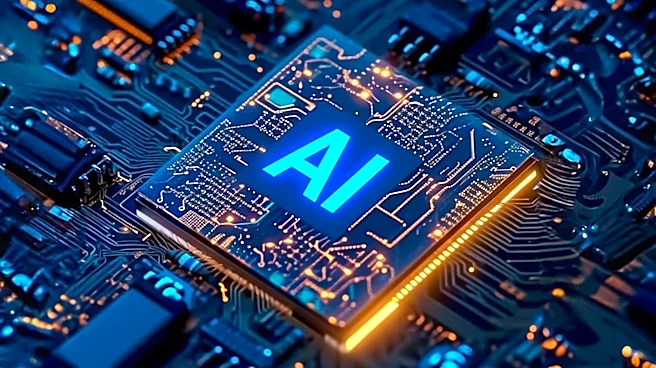
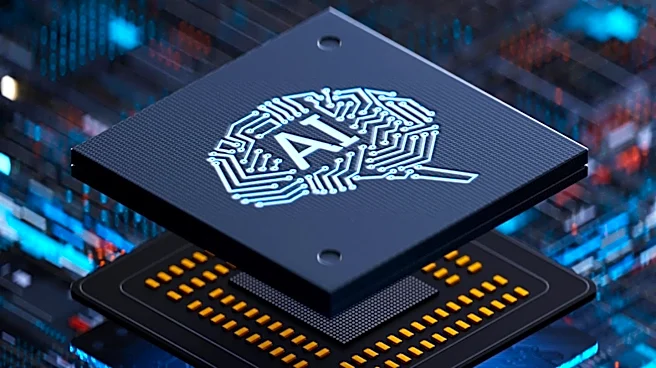
Artificial intelligence (AI) is increasingly being integrated into electronic design automation (EDA), the software used for designing computer chips. This integration, known as AI EDA, encompasses three main areas: machine learning (ML) to optimize chip implementation
for power, performance, and area; large language models (LLMs) that assist engineers in writing and understanding hardware code; and AI agents that automate entire design tasks, such as writing Register-Transfer Level (RTL) code, building tests, and debugging. While AI can significantly enhance efficiency in various stages of chip design, from specification to verification and physical design, it currently cannot design a complete, production-ready chip independently. Human engineers remain crucial for architectural decisions, integration, and final sign-off.
Why It's Important?
The adoption of AI EDA is transforming the U.S. semiconductor industry by accelerating design cycles and improving chip performance. This innovation allows companies to bring more complex and efficient chips to market faster, which is critical in the highly competitive technology landscape. By automating repetitive and time-consuming tasks, AI EDA frees up engineers to focus on higher-level design challenges, addressing the shortage of experienced designers. This can lead to significant cost savings and a competitive advantage for companies that effectively leverage these tools. However, it also introduces challenges related to the reliability of AI-generated code, data security, and the need for robust verification processes to ensure correctness.
What's Next?
The trend towards more autonomous AI agents in chip design is expected to continue, with agents taking on increasingly complex tasks across various EDA tools. Companies like Synopsys, Cadence, and Siemens EDA are actively developing and integrating these agentic workflows. Future developments will likely focus on improving the accuracy and trustworthiness of AI-generated hardware, enhancing data control mechanisms for intellectual property protection, and developing more comprehensive benchmarks that reflect real-world chip design complexities. The role of chip designers will evolve, shifting towards more oversight, architectural planning, and validation of AI-generated outputs.
Beyond the Headlines
The integration of AI into chip design raises fundamental questions about the future of engineering and human-machine collaboration. While AI can augment human capabilities, the reliance on AI-generated code necessitates rigorous verification and validation to prevent subtle errors that could have significant consequences in hardware. Concerns about intellectual property leakage and data privacy are also paramount, as chip designs are highly valuable assets. The development of AI EDA tools could also democratize chip design to some extent, making advanced capabilities more accessible, but it also requires a skilled workforce capable of effectively utilizing and overseeing these sophisticated AI systems.