







What's Happening?
Keysight Technologies reported robust fiscal third-quarter 2026 revenue of $1.85 billion, a significant increase from $1.35 billion in the same quarter of fiscal 2025, marking a 37% year-over-year jump. This growth is largely attributed to the surging
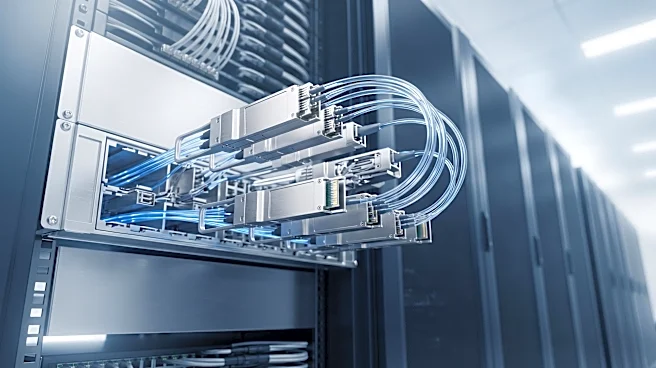
demand for AI data-center infrastructure. The company, known for its electronic test and measurement solutions, saw its GAAP net income more than double to $397 million, or $2.30 per share, compared to $191 million, or $1.10 per share, a year earlier. Non-GAAP net income also rose substantially to $531 million, or $3.07 per share. Keysight's AI-related business, primarily in the wireline segment, was in the range of $500 million to $600 million for the first half of the fiscal year, indicating its growing importance to the company's overall performance. The demand drivers include high-speed interconnects, optical transceivers, AI data-center networking, and advanced semiconductors, particularly for 1.6T and emerging 3.2T networking speeds.
Why It's Important?
Keysight's strong performance highlights the critical role of test and measurement solutions in the rapidly expanding AI and high-performance computing sectors. As AI infrastructure becomes more complex and data transfer speeds increase, the need for precise validation and testing equipment becomes paramount. Keysight's ability to provide solutions for 1.6T and emerging 3.2T networking, silicon photonics, and co-packaged optics positions it as a key enabler for the next generation of AI data centers. This growth indicates that investments in AI infrastructure are not only benefiting chipmakers and cloud providers but also companies that supply the foundational tools for development and deployment. The company's operating leverage, with profit growing faster than sales, suggests a shift towards higher-value work in advanced AI networking and semiconductor validation, which is crucial for maintaining technological leadership and efficiency in the industry.
What's Next?
Keysight anticipates continued strong demand from the AI sector, with its CEO, Satish Dhanasekaran, emphasizing AI as a primary growth engine. The company's order growth, which outpaced revenue in the previous quarter, suggests a healthy backlog that will fuel future sales. As 3.2T networking standards mature, Keysight expects increased demand for its testing solutions in this area. The company will likely continue to focus on developing advanced tools for silicon photonics and co-packaged optics, which are critical for future AI infrastructure. However, the company faces risks such as customer concentration in AI spending, potential budget adjustments by hyperscalers, and the challenge of sustaining high growth rates on a larger revenue base. Competition in co-packaged optics validation is also expected to intensify, requiring Keysight to maintain its innovation edge.
Beyond the Headlines
Keysight's success in the AI infrastructure market reflects a broader trend where specialized technology providers are becoming indispensable to the digital transformation. The 'picks and shovels' argument, where companies supplying essential tools benefit from a gold rush, is particularly relevant here. This dynamic underscores the interconnectedness of the technology ecosystem, where advancements in one area, like AI, create ripple effects across various supporting industries. The increasing complexity of AI hardware and networking also raises the bar for engineering and quality assurance, making robust testing solutions non-negotiable. This could lead to greater standardization in testing protocols and a higher demand for skilled professionals in test and measurement, further solidifying the importance of companies like Keysight in the technological landscape.