






What's Happening?
Zipline, a drone delivery and logistics company, is reportedly in discussions for a new funding round of approximately $1 billion, which could value the company at around $20 billion. This potential valuation would be nearly three times the $7.6 billion valuation it
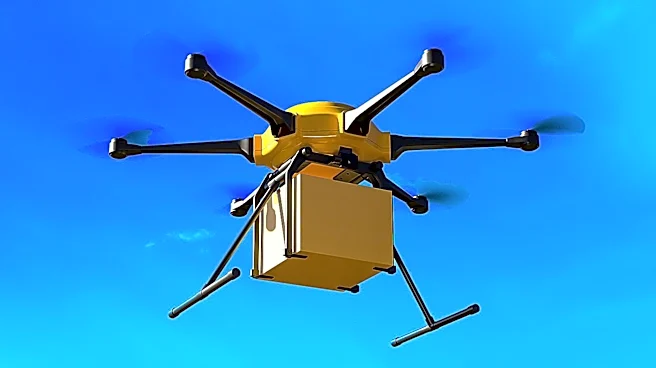
received earlier this year in a financing round aimed at expanding commercial deployment. The negotiations are currently in early stages, and the figures may change. Paradigm, an existing investor in Zipline, is reportedly in talks to lead this round, with prior backer Tiger Global Management also considering participation. Zipline's services include delivering meals to customers' doorsteps within 30 minutes, utilizing fulfillment software, inventory management, and airspace tools. The company operates in both rural and urban communities and has completed nearly 3 million deliveries over 140 million miles. Its customers include major companies like Chipotle Mexican Grill Inc., Jimmy John's, and Walmart Inc. In August, Zipline also announced a partnership with Uber Technologies Inc., which included an investment from Uber, to expand its food-delivery operations.
Why It's Important?
This potential funding round and valuation for Zipline signal a significant shift in investor confidence towards autonomous delivery and logistics moving from experimental stages to mainstream adoption in the U.S. A $20 billion valuation would underscore the growing belief that drone delivery can become an everyday service, impacting various U.S. industries, particularly retail, food service, and healthcare logistics. For consumers, it could mean faster and more efficient delivery options, especially in areas traditionally underserved by conventional delivery methods. For businesses, it presents opportunities for cost reduction in last-mile delivery and expanded reach. The involvement of major investors like Paradigm and Tiger Global Management, alongside partnerships with companies like Uber and Walmart, indicates a strong market validation for Zipline's technology and business model. This development could also influence the valuation of other private companies in the autonomous delivery space and set benchmarks for public companies looking to enter or expand in this sector.
What's Next?
The ongoing negotiations for Zipline's funding round will determine the final amount raised and the company's valuation. If successful, this capital injection will likely fuel further expansion of Zipline's drone delivery services across the U.S. and potentially internationally. This could involve increasing its fleet of drones, enhancing its technological infrastructure, and forging more partnerships with retailers and food service providers. The company's focus on both rural and urban communities suggests a broad strategy for market penetration. The success of this funding round could also encourage more investment in the broader autonomous delivery sector, leading to increased competition and innovation. Stakeholders, including investors, businesses, and consumers, will be watching closely to see how Zipline leverages this potential capital to scale its operations and solidify its position as a leader in drone logistics.
Beyond the Headlines
Zipline's potential $20 billion valuation and significant funding round highlight deeper societal and economic transformations driven by autonomous technology. Ethically, the widespread deployment of delivery drones raises questions about airspace regulation, noise pollution, and potential job displacement in traditional delivery sectors. Legally, it necessitates the development of robust regulatory frameworks for drone operations, safety standards, and liability in case of accidents. Culturally, it represents a further integration of automation into daily life, potentially altering consumer expectations for convenience and speed. The long-term implications include a redefinition of logistics and supply chains, potentially making them more resilient and efficient. However, it also brings challenges related to infrastructure development, public acceptance of drone technology, and ensuring equitable access to these advanced delivery services across different socioeconomic groups. The shift towards autonomous delivery could also have environmental benefits through reduced vehicle emissions, depending on the energy sources used for drone operations.