



What's Happening?
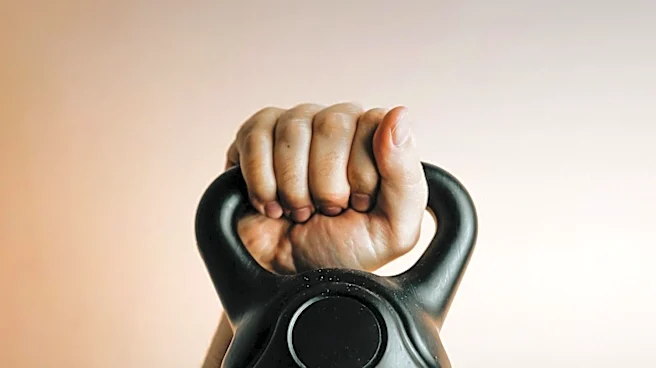
A new exercise called the 'Towel Reaper,' shared by kettlebell trainer Dan Ford, is gaining attention for its effectiveness in developing rock-solid biceps and unbreakable grip strength. This simple movement requires only a kettlebell and a hand towel.
To perform the exercise, a hand towel is threaded halfway through the kettlebell handle, and then each end of the towel is gripped in each hand, allowing the kettlebell to hang freely. The exercise involves performing alternating bicep curls, bringing one hand towards the shoulder while the other lowers towards the kettlebell. The key to its effectiveness lies in the instability created by suspending the kettlebell from the towel. This forces the hands and forearms to constantly work to control the shifting and swinging load, placing significant demands on grip strength and forearm endurance, in addition to engaging the biceps. The alternating nature of the curls ensures both arms are continuously working, with one arm actively curling and the other stabilizing the kettlebell.
Why It's Important?
The introduction of the 'Towel Reaper' exercise is important for the U.S. fitness community and individuals seeking innovative ways to enhance their strength training. This exercise offers a unique and challenging method to target grip strength, which is often overlooked but crucial for overall functional fitness, athletic performance, and injury prevention. For athletes and fitness enthusiasts, incorporating such a movement can lead to significant improvements in their ability to handle heavier weights in other exercises and enhance their performance in sports requiring strong grip. From an industry perspective, the popularity of novel exercises like the 'Towel Reaper' can drive interest in kettlebell training and related accessories, benefiting manufacturers and retailers. Moreover, it highlights the ongoing creativity within the fitness sector to maximize the utility of existing equipment, providing accessible and effective workout variations that don't require specialized or expensive gear. This can also inspire trainers to explore and share more unconventional yet effective training methods.
What's Next?
As the 'Towel Reaper' gains visibility, it is likely to be adopted by more fitness enthusiasts and trainers, potentially leading to its integration into various workout routines and online fitness content. We can expect to see demonstrations and tutorials of this exercise appearing across social media platforms and fitness websites, further popularizing its use. Kettlebell manufacturers might subtly benefit from increased interest in their products as more people seek to try this and similar exercises. Fitness coaches and personal trainers may also incorporate the 'Towel Reaper' into their clients' programs, particularly for those looking to improve grip strength, forearm development, and bicep hypertrophy. There could also be discussions and adaptations of the exercise, with variations emerging to suit different fitness levels and goals, further expanding its utility within the broader fitness landscape.
Beyond the Headlines
The 'Towel Reaper' exercise, while seemingly simple, taps into a deeper principle of training: leveraging instability to enhance muscle activation and strength. This approach moves beyond traditional fixed-path movements, promoting greater proprioception and neuromuscular control. Ethically, it underscores the idea that effective training doesn't always require complex or expensive equipment, making high-quality strength development accessible to a wider audience. Culturally, the sharing of such innovative exercises by individuals like Dan Ford highlights the collaborative and evolving nature of the fitness community, where practical, real-world applications are valued. It also challenges the perception that all effective exercises must be scientifically validated in a lab, demonstrating the power of experiential knowledge and creative problem-solving in fitness. This could foster a greater appreciation for functional and adaptable training methods that prioritize overall physical resilience and capability.