






What's Happening?
J.P. Morgan Asset Management indicates that the extensive build-out of Artificial Intelligence (AI) infrastructure is leading to a repricing of credit markets. After a period of historically tight spreads, credit has become more expensive and conditional,
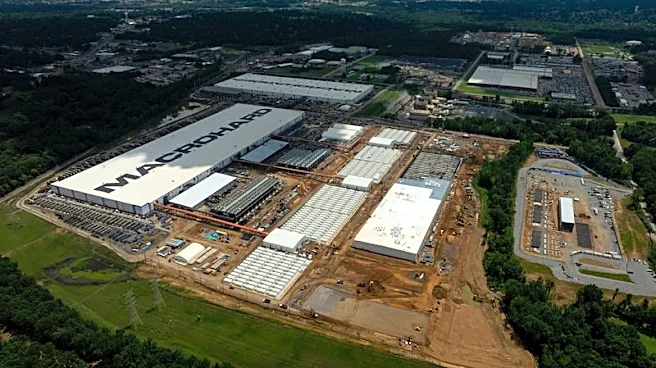
with investors showing increased discernment, particularly in AI-related debt. The firm notes that capital is still available but its cost is now more dependent on transaction structure. This shift is evident as AI-related debt issuance reached nearly $600 billion year-to-date in 2026, a significant increase from $226 billion in 2025. The financing of AI infrastructure has expanded beyond hyperscalers' investment-grade bonds to include high-yield borrowers and securitized structures. Furthermore, the November U.S. midterm elections have introduced potential delays for data center projects, especially in Texas, Ohio, and Georgia, due to increased scrutiny over grid capacity and local incentives. Despite these potential delays, J.P. Morgan Asset Management does not anticipate a material reduction in demand for AI infrastructure, as U.S. hyperscalers can adapt by expanding existing sites or developing new capacity domestically or internationally.
Why It's Important?
The repricing of credit in the AI sector signifies a maturing investment landscape where capital is no longer as readily available or cheap. This shift impacts both borrowers and lenders. For companies reliant on favorable financing terms, the increased differentiation in credit markets raises the stakes, demanding more robust financial structures and clearer repayment strategies. Lenders, conversely, gain more bargaining power, allowing them to negotiate better pricing and terms. This dynamic could influence the pace and nature of AI development, potentially favoring more financially stable entities or those with innovative financing models. The increased scrutiny on data center projects post-midterm elections highlights growing local and state-level concerns regarding infrastructure strain and environmental impact, which could lead to policy changes affecting where and how AI infrastructure is developed within the U.S. While J.P. Morgan Asset Management believes overall AI demand will remain strong, these localized challenges could create regional disparities in AI development and investment.
What's Next?
Looking ahead, the AI build-out will likely face continued scrutiny regarding financing structures and project approvals. Investors will increasingly focus on repayment risks, particularly for projects relying on cash flows and transaction structures rather than large corporate balance sheets. This could lead to more complex and tailored financing deals in the AI debt market. State policies in key regions like Texas, Ohio, and Georgia may evolve to address concerns about grid capacity and local incentives, potentially leading to further delays or shifts in data center development locations. U.S. hyperscalers are expected to adapt by exploring alternative expansion strategies, including developing capacity in new domestic or international locations to circumvent localized hurdles. J.P. Morgan Asset Management maintains its forecast for AI capital expenditure in 2028 and 2029 to remain above consensus, even with anticipated post-election delays, indicating a sustained, albeit more complex, investment trajectory in AI infrastructure.
Beyond the Headlines
The evolving credit landscape for AI infrastructure points to a broader trend of increased financial discipline in high-growth technology sectors. This could signal a move away from the 'growth at all costs' mentality that characterized earlier tech booms, towards a more sustainable and risk-aware investment environment. The localized resistance to data center projects, driven by concerns over energy consumption and community impact, also highlights a growing tension between technological advancement and local environmental and social considerations. This could lead to a more decentralized approach to AI infrastructure development, with companies seeking locations that offer more favorable regulatory and community environments. Furthermore, the increased cost of capital might spur innovation in more energy-efficient AI technologies and data center designs, as companies seek to optimize operational costs in response to tighter financial conditions. This could ultimately lead to a more resilient and environmentally conscious AI ecosystem.