




What's Happening?
Rustic Strength, a family-run company based in the Missouri Ozarks, has established a closed-loop refill program for its plant and animal-based cleaning and personal care products. This initiative allows customers to return empty product containers, including
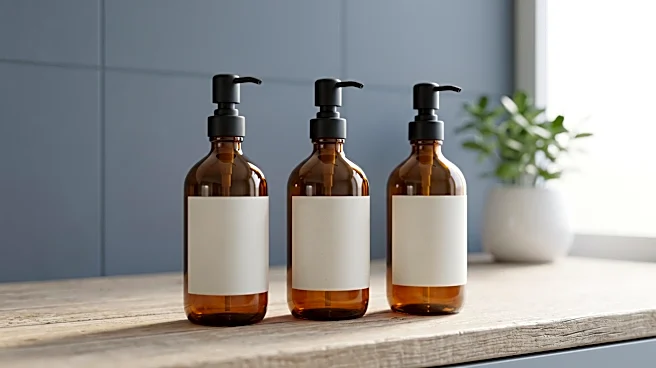
one-gallon jugs, five-gallon containers, and barrels, to the company for sanitization and reuse. The company actively encourages customers to save shipping boxes and send back empty containers in exchange for store credit. This system aims to significantly reduce single-use plastic waste. Rustic Strength also operates through two models: an at-home bulk model where families can order five-gallon containers for their own refill stations, and a wholesale and refill-shop program that partners with hundreds of independent local refill stations across the nation. These local partnerships have collectively prevented over 1.3 million single-use bottles from entering landfills. The company emphasizes strict ingredient transparency, avoiding harsh chemicals like phthalates, parabens, and formaldehyde-releasing agents, and ensuring products are free from 1,4-dioxane, a likely human carcinogen often found as a byproduct in ethoxylated alcohols.
Why It's Important?
This closed-loop refill program by Rustic Strength represents a significant step towards a more sustainable consumer economy in the U.S. By offering a practical and accessible way for consumers to reduce plastic waste, it addresses growing environmental concerns and consumer demand for eco-friendly options. The company's commitment to ingredient transparency and avoidance of harmful chemicals sets a higher standard for product safety and environmental responsibility within the cleaning and personal care industry. This approach not only benefits the environment by diverting millions of plastic bottles from landfills but also empowers consumers to make more informed and sustainable choices. Furthermore, Rustic Strength's focus on supporting small businesses through its wholesale and refill-shop program strengthens local economies and fosters a grassroots movement for sustainable consumption, contrasting with the traditional model of large big-box retailers. This model could inspire other manufacturers to adopt similar circular economy principles, driving broader industry change.
What's Next?
Rustic Strength plans to continue expanding its network of local refill stations and its product line, which has already grown from laundry detergent to include hand soap, dish soap, shampoo, conditioner, and multi-purpose cleaners. The company also acts as a bridge for aspiring entrepreneurs in the skincare or cleaning line industry, offering low-threshold wholesale options to help small businesses launch their brands. This support system could lead to a proliferation of smaller, ethically-minded businesses offering sustainable products. The success of Rustic Strength's closed-loop system and its partnerships with local refill shops may encourage larger corporations to re-evaluate their packaging and distribution strategies, potentially leading to more widespread adoption of refill and reuse models across various consumer goods sectors. Continued consumer demand for transparent, eco-friendly products will likely drive further innovation and expansion in this market segment.
Beyond the Headlines
The initiative by Rustic Strength highlights a broader cultural shift towards conscious consumerism and environmental responsibility in the U.S. It challenges the prevailing linear economic model of 'take-make-dispose' by demonstrating the viability and success of a circular economy approach. This movement extends beyond mere product sales, fostering community engagement through local refill stations and supporting small businesses, thereby creating a more resilient and localized economic ecosystem. The company's origin story, driven by a family's personal health struggles with conventional products, underscores the deep connection between environmental health and human well-being, pushing for a re-evaluation of chemical use in everyday household items. This model also implicitly educates consumers about the lifecycle of products and packaging, encouraging a more mindful approach to consumption and waste generation. The long-term implications could include a significant reduction in plastic pollution and a shift in consumer expectations regarding corporate environmental accountability.