




What's Happening?
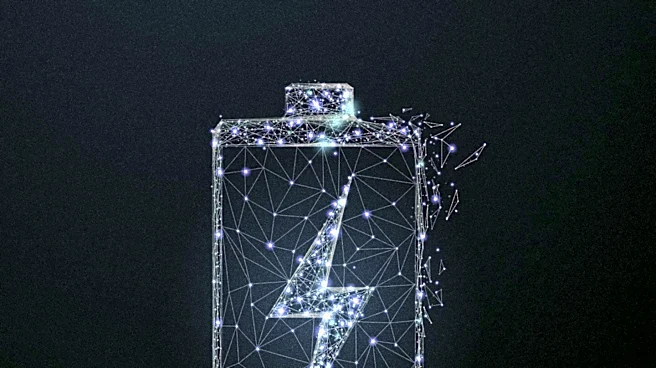
Sodium-ion battery technology is rapidly gaining attention in the United States as a viable alternative to lithium-ion batteries, driven by concerns over supply chain vulnerabilities and rising energy demand. The global market for sodium-ion batteries, valued
at less than $1 billion in 2024, is projected to reach nearly $29 billion by 2034. Companies like Mana Battery and Alsym Energy, members of the American Battery Leadership Coalition, are promoting sodium-ion batteries for their economic and security benefits. The U.S. possesses vast domestic reserves of sodium, reducing reliance on imports that characterize the lithium supply chain, which is largely dominated by China. Innovations in sodium-ion battery development focus on creating low-cost, energy-efficient solutions for long-duration energy storage, with advantages in safety, power, and longevity, making them suitable for grid stability, data centers, and various infrastructure applications.
Why It's Important?
The growing interest in sodium-ion batteries is critical for enhancing U.S. energy security and fostering domestic economic growth. By leveraging abundant domestic sodium reserves, the U.S. can mitigate geopolitical risks and supply chain disruptions associated with lithium. This shift supports localized battery production, creating job opportunities and strengthening the national manufacturing base, which is particularly relevant amidst the expanding AI race and increasing energy demands. Sodium-ion batteries offer inherent safety advantages, such as lower flammability risk and stability at high temperatures, making them ideal for indoor installations and critical infrastructure. Their ability to be manufactured in existing lithium-ion plants with minimal retrofitting also accelerates adoption and scaling, providing a cost-effective solution for the burgeoning energy storage market and contributing to grid stability.
What's Next?
The sodium-ion battery sector is poised for significant growth and investment in the coming years. Companies like Mana Battery are innovating with anode-free sodium-ion cells to reduce material costs and are partnering with existing battery manufacturers to scale production using existing gigafactories. The American Battery Leadership Coalition will likely continue its advocacy for domestic sodium-ion battery production, attracting interest across the political spectrum due to its economic and security implications. Further technological advancements are expected, with companies exploring diverse chemistries for various applications, from high-power hybrid automotive systems to short-duration backup for data centers. Increased capital allocation from generalist and deep-tech funds is predicted, driving further innovation and market penetration for sodium-ion technologies.
Beyond the Headlines
The emergence of sodium-ion battery technology represents a strategic diversification in the energy storage landscape, moving beyond the near-exclusive reliance on lithium-ion. This diversification has profound implications for national industrial policy, encouraging the development of entirely new domestic supply chains and manufacturing capabilities. It also highlights a broader trend in materials science to find sustainable and geopolitically stable alternatives for critical technologies. The flexibility of sodium-ion chemistry, allowing for varied use-cases from grid-scale storage to specialized industrial applications, underscores its potential to address a wide array of energy challenges. This technological shift could also foster greater resilience in the U.S. energy infrastructure, making it less susceptible to global market fluctuations and external pressures, thereby reinforcing long-term economic stability and technological sovereignty.