







What's Happening?
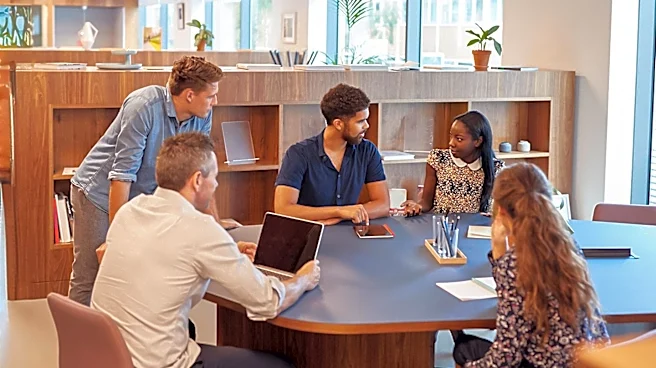
The tech industry has largely adopted a hybrid work model, with the '3-2 model' becoming the operational default for a significant portion of the global IT sector. This model typically involves employees working three days in the office for collaborative
tasks and two days at home for focused work. This shift is a compromise between fully remote and traditional on-site work, aiming to balance flexibility with in-person interaction. While senior professionals often thrive in remote settings due to their established self-direction, junior developers and early-career professionals benefit significantly from the physical proximity to senior engineers in hybrid or on-site environments. This allows for faster mentorship, quicker resolution of issues, and immersive learning experiences. The hybrid approach is seen as a mature reality in the modern employment landscape, with flexible scheduling being a dominant model for knowledge workers.
Why It's Important?
The widespread adoption of the hybrid model in the tech industry has significant implications for workforce management, talent acquisition, and employee development. For companies, it allows access to a broader talent pool while still fostering team cohesion and collaboration that can be challenging in fully remote setups. The '3-2 model' specifically aims to optimize productivity by allocating dedicated time for both collaborative brainstorming and individual deep work. For employees, particularly junior developers, the hybrid model offers a crucial balance, providing the flexibility of remote work alongside the essential mentorship and learning opportunities derived from in-person interactions with experienced colleagues. This structure can help mitigate feelings of isolation often associated with fully remote work and prevent burnout by establishing clearer boundaries between personal and professional life. However, it also introduces challenges in scheduling and ensuring consistent communication across a distributed team.
What's Next?
The tech industry will likely continue to refine its hybrid work strategies, focusing on optimizing the balance between in-office collaboration and remote flexibility. Companies will need to invest in robust scheduling tools and communication platforms to manage distributed teams effectively and ensure seamless workflows. There will be an ongoing emphasis on creating inclusive work environments that cater to both in-office and remote employees, preventing a two-tiered system. Furthermore, the success of hybrid models will depend on leadership's ability to foster a culture of trust and accountability, empowering employees to manage their time and tasks efficiently regardless of their location. The evolution of hybrid work will also influence office space design, with a greater focus on collaborative zones and flexible workstations rather than traditional individual offices.
Beyond the Headlines
The shift to hybrid work in the tech sector reflects a broader societal re-evaluation of work-life balance and the nature of productivity. It challenges traditional notions of what constitutes a 'workplace' and emphasizes outcomes over physical presence. This model could lead to long-term changes in urban planning, as demand for traditional office spaces may decrease, while demand for co-working spaces and suburban office hubs might increase. Ethically, companies must ensure equitable access to resources and opportunities for all employees, regardless of their work location, to prevent potential disparities in career progression. The hybrid model also highlights the importance of digital literacy and self-management skills for employees, as they are increasingly responsible for structuring their own workdays and maintaining productivity in varied environments. This evolution could also influence educational curricula, with a greater emphasis on skills relevant to distributed and flexible work arrangements.