



What's Happening?
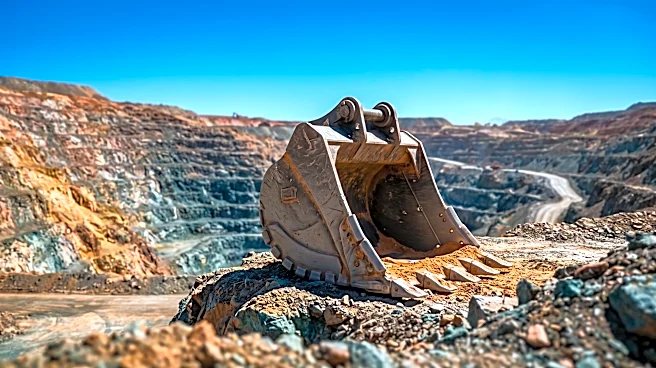
Investors in Pakistan's Reko Diq copper and gold project are considering postponing the start of production from 2028 to 2030. This potential delay is attributed to the security situation in Balochistan province and the ongoing conflict in neighboring
Iran, according to government sources and industry representatives cited by Dawn. Canadian company Barrick Mining, which owns 50% of the project, initiated an internal review in February 2026, leading to a slowdown in development and an extended assessment period until early 2027. While full-scale development might resume in mid-2027, Barrick has not yet released an updated construction schedule. Despite the slowdown, the project has maintained its 700 permanent employees and approximately 2,000 contract workers, with research and administrative work continuing.
Why It's Important?
The potential delay of the Reko Diq project carries significant implications for the global copper and gold markets, which could indirectly affect U.S. industries reliant on these commodities. Copper is vital for electronics, construction, and renewable energy technologies, while gold serves as a key investment and industrial material. A delay in a major project like Reko Diq could contribute to supply constraints, potentially driving up prices and increasing costs for U.S. manufacturers and consumers. Furthermore, the security concerns highlighted in Balochistan and the regional instability in Iran underscore the geopolitical risks associated with international mining investments. For U.S. companies with global supply chains or investments in the mining sector, such delays emphasize the need for robust risk assessment and diversification strategies to mitigate the impact of regional conflicts and security challenges on commodity availability and pricing.
What's Next?
Barrick Mining is expected to complete its internal review by early 2027, which will likely inform an updated construction schedule for the Reko Diq project. The resumption of full-scale development hinges on an improved security situation in Balochistan, as indicated by Barrick's chief executive. The project's estimated investment has already increased from $4 billion to $5.6 billion for the first phase, with a total capital expenditure potentially reaching $9.1 billion. Further delays could lead to additional cost increases, with industry sources estimating a rise of $450 million to $900 million. The project aims to create 7,500 jobs during peak construction and 4,000 permanent jobs after launch, making its timely progression crucial for regional employment and economic stability.
Beyond the Headlines
The Reko Diq project's challenges extend beyond immediate financial and operational concerns, touching upon deeper issues of resource nationalism, regional stability, and the social license to operate. The security situation in Balochistan, a region with a history of insurgency, highlights the complex interplay between economic development and local grievances. The war in neighboring Iran further complicates the geopolitical landscape, creating an environment of uncertainty for large-scale foreign investments. For mining companies, operating in such volatile regions requires navigating intricate political, social, and environmental considerations. The project's ability to proceed will serve as a test case for how international corporations manage risks in conflict-affected areas, balancing economic imperatives with ethical responsibilities and community engagement. The long-term success of Reko Diq could set a precedent for future resource development in challenging global contexts.