







What's Happening?
Amazon Web Services (AWS) has recorded its fastest growth in nearly five years, with a 39% increase in its cloud segment and a cloud backlog reaching $578 billion. Despite these strong performance indicators, Amazon's shares experienced a decline of 6.72%
in premarket trading after its third-quarter results were released. The company's revenue came in at $201.94 billion, slightly below the estimated $202.20 billion, and earnings per share (EPS) of $1.89 missed expectations of $1.9579. The market's reaction appears to be primarily focused on Amazon's substantial capital expenditure (capex) plan of $220 billion, rather than the robust growth in its cloud division. Operating income, however, rose by 61.15% to $28.08 billion, achieving Amazon's highest-ever operating margin of 13.9%. The company noted that Prime Day shifting to Q2 and a $9.5 billion gain from Anthropic in the year-ago quarter distorted year-over-year comparisons.
Why It's Important?
The divergence between AWS's strong growth and Amazon's stock performance highlights a critical tension for investors in the technology sector. While AWS is a dominant player in the cloud computing and artificial intelligence (AI) race, the market's apprehension about the massive capital expenditure signals concerns about future profitability and cash flow. This situation could impact investor confidence in other tech giants undertaking significant investments in AI infrastructure. For the broader U.S. business landscape, Amazon's continued investment in AI and cloud services indicates a sustained push towards digital transformation across industries. The company's plans to sell chips to outside customers by late 2027 could also intensify competition in the semiconductor market, affecting established players and potentially fostering innovation in AI hardware. The market's focus on capex over revenue growth suggests a cautious outlook on long-term returns, potentially influencing investment strategies across the tech industry.
What's Next?
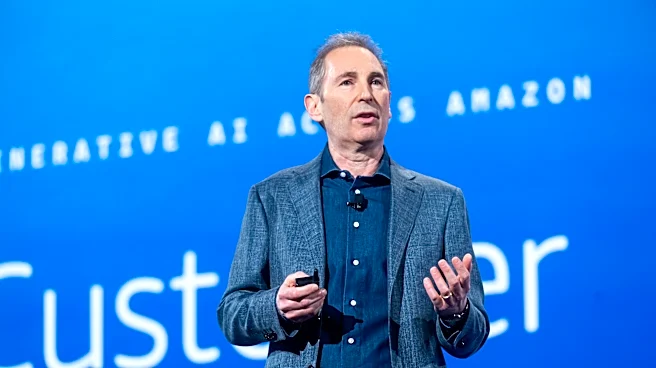
Amazon CEO Andy Jassy projects AWS growth to exceed 40% in both 2027 and 2028, indicating continued aggressive expansion in the cloud and AI sectors. The company plans to begin selling its custom-designed chips to external customers by late 2027, which could open new revenue streams and further solidify its position in the AI hardware market. Advertising growth is also expected to remain strong, with projections in the high teens for Q4. Investors will closely monitor whether the substantial capital expenditures translate into expanded margins and sustained profitability. The success of Trainium's outside sales and the efficiency of AI capex in generating returns will be key metrics. The market's current 'mispricing' of the stock, as some analysts suggest, could correct if AWS continues its accelerated growth and the capex investments prove fruitful, potentially leading to a significant rebound in Amazon's share price.
Beyond the Headlines
The market's reaction to Amazon's earnings, prioritizing capital expenditure concerns over impressive cloud growth, reflects a broader shift in investor sentiment towards tech companies. There's an increasing scrutiny on the financial sustainability of aggressive growth strategies, particularly those involving massive investments in emerging technologies like AI. This could lead to a re-evaluation of valuation models for tech stocks, where immediate profitability and efficient capital deployment might gain precedence over sheer revenue expansion. The ethical and environmental implications of such large-scale data center expansions, including energy consumption and resource allocation, could also become more prominent considerations for stakeholders. Furthermore, Amazon's move into selling its own chips could signify a strategic vertical integration trend within the tech industry, aiming for greater control over the supply chain and potentially reducing reliance on third-party vendors, which could have long-term competitive ramifications.