





What's Happening?
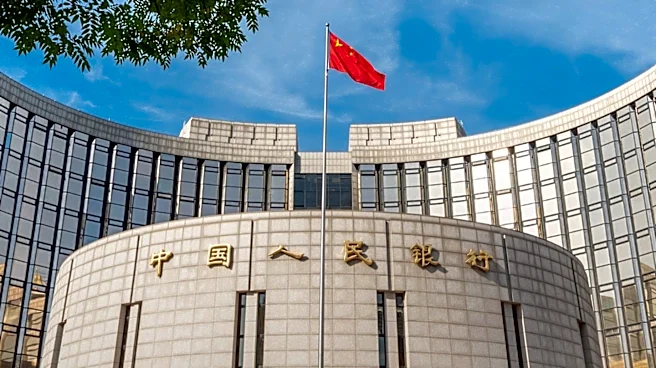
The People's Bank of China (PBOC) has officially changed its policy rate anchor from the 7-day reverse repo rate to the overnight (1-day) reverse repo rate, effective November 2. The new operation rate is set at 1.25%. Concurrently, the 7-day reverse repo will
no longer function as a primary policy rate and will transition to multi-price tendering, primarily utilized during periods of high liquidity fluctuation such as month-ends and tax seasons. This adjustment means the previous 7-day reverse repo rate of 1.40% is no longer part of the policy rate sequence, establishing the new short-end policy rate center at 1.25%. This move is not considered a rate cut but rather a realignment of the term premium, according to several academics. The shift is a culmination of a nearly three-decade evolution in China's monetary policy framework, moving from quantity-based tools to a more price-based system.
Why It's Important?
This policy shift by the PBOC is significant as it refines China's monetary policy framework, aligning it more closely with international central banking practices that target overnight rates. The change addresses a mismatch between the PBOC's regulatory target and its operational tools. Previously, the PBOC targeted the overnight rate (DR001), which accounts for over 90% of daily interbank market turnover, but used a 7-day tool. This created a 'overnight target, 7-day tool' maturity mismatch, leading to potential distortion and dilution of policy signals. By aligning the operational tool with the regulatory target, the PBOC aims to improve the clarity and effectiveness of its monetary policy transmission. This move is crucial for managing a demand-constrained economy, especially as the real estate sector faces challenges and debt burdens increase, indicating a strategic shift from financing an investment boom to managing economic demand.
What's Next?
The immediate consequence of this shift is a more granular and precise regulation of the money market, moving from a 'weekly' to a 'daily' basis. The PBOC's focus will now be on managing liquidity and guiding short-term market rates more directly through the overnight reverse repo. This refined approach is expected to enhance the central bank's ability to respond to market conditions and transmit policy signals more smoothly. While the change is not a rate cut, its impact on market expectations and liquidity management will be closely watched. The PBOC will continue to manage a demand-constrained economy, and the effectiveness of this new policy anchor in stimulating demand and addressing debt burdens will be a key area of observation for financial markets and economic analysts.
Beyond the Headlines
This policy adjustment reflects a deeper strategic evolution in China's financial governance, moving towards a more sophisticated and market-oriented monetary policy. The transition from a 'dual anchor' system, which included the 7-day reverse repo and the 1-year Medium-term Lending Facility (MLF) rate, to a single overnight anchor, signifies a maturation of China's central banking system. This move also highlights the PBOC's ongoing efforts to enhance the transmission mechanism of its monetary policy, ensuring that short-term market rates accurately reflect the central bank's stance. The shift away from the MLF's policy role, which began in 2024, and its full return to being a pure liquidity tool in early 2025, underscores a deliberate strategy to streamline and clarify policy signals. This evolution is critical for China as it navigates complex economic challenges, including a struggling real estate sector and mounting debt, by providing a more agile and responsive monetary policy framework.