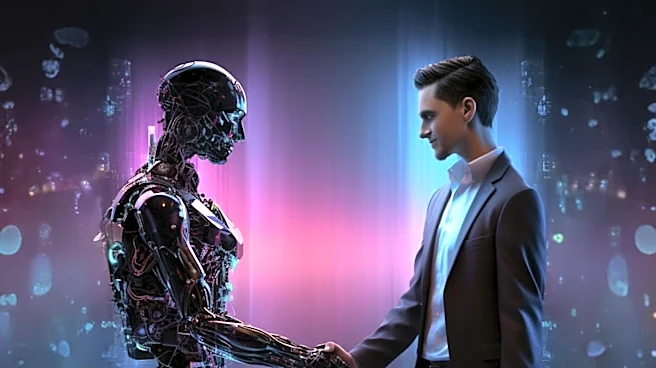

What's Happening?
Aravind Srinivas, the Cofounder and CEO of Perplexity, has articulated a vision for utilizing 'Teammates'—presumably AI-powered assistants—to support individuals in both their professional and personal
lives. Srinivas suggests that these AI teammates can fulfill various roles, providing assistance where help is needed. A key aspect of this concept is the idea of a 'chief of staff teammate,' which would be capable of coordinating other AI teammates. This implies a hierarchical or managerial structure within the AI assistant ecosystem, where one AI entity could oversee and direct the tasks of others to streamline support and efficiency for the user. This perspective highlights a potential future where AI plays a more integrated and organizational role in daily tasks.
Why It's Important?
This development is significant for the U.S. technology sector and the broader economy as it points towards an evolving landscape of AI applications. The concept of AI 'Teammates' could revolutionize productivity tools, offering advanced solutions for task management, information synthesis, and personal assistance. For businesses, this could mean enhanced operational efficiency, reduced administrative burdens, and potentially a shift in how human-AI collaboration is structured. Individuals could benefit from more sophisticated personal assistants capable of managing complex schedules and coordinating various aspects of their lives. The 'chief of staff' model suggests a move beyond simple AI tools to more complex, interconnected AI systems that can manage and delegate, potentially creating new job categories in AI management and oversight, while also impacting existing roles that involve coordination and administrative tasks.
What's Next?
The immediate next steps would likely involve further development and refinement of the AI 'Teammate' concept by Perplexity and other AI companies. This could include the creation of prototypes, beta testing with early adopters, and gathering user feedback to iterate on the functionality and user experience. We might see increased investment in AI research focused on multi-agent systems and AI coordination. The broader tech industry will be watching closely to see how this concept translates into practical applications and market adoption. Regulatory discussions around AI's role in the workplace, data privacy, and ethical implications of AI autonomy could also intensify as these advanced AI systems become more prevalent. The success of such systems will depend on their ability to seamlessly integrate into existing workflows and provide tangible benefits.
Beyond the Headlines
The introduction of AI 'Teammates,' particularly with a 'chief of staff' function, raises profound questions about the future of work, human-AI interaction, and the nature of intelligence itself. Ethically, it prompts considerations about accountability when AI systems are coordinating tasks and making decisions. Legally, it could necessitate new frameworks for intellectual property, liability, and data governance in environments where AI agents are actively managing and creating. Culturally, it challenges traditional notions of teamwork and leadership, potentially leading to a redefinition of human roles in collaborative settings. The long-term shift could see a more symbiotic relationship between humans and AI, where AI systems are not just tools but active, coordinating participants in daily operations, fundamentally altering how we approach problem-solving and task execution.