



What's Happening?
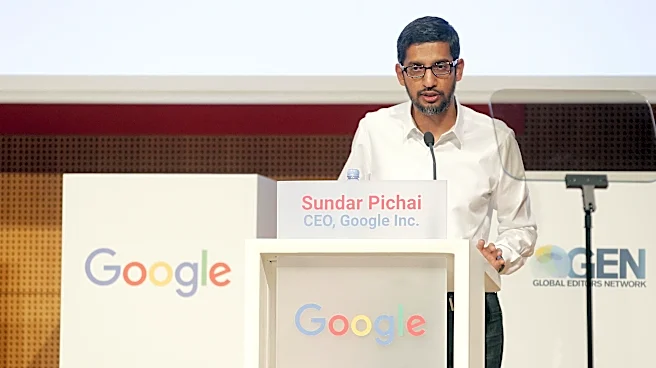
Alphabet CEO Sundar Pichai has been ranked as the top Indian-origin business leader in the HSBC Hurun Global Indians List 2026, surpassing Microsoft CEO Satya Nadella. Alphabet's valuation reached $4.2 trillion, contributing to Pichai's leading position.
Nadella is now in second place, followed by Micron Technology CEO Sanjay Mehrotra. YouTube CEO Neal Mohan and Google Cloud CEO Thomas Kurian complete the top five. The 2026 list features 236 Indian-origin executives leading 200 companies headquartered outside India. These companies collectively hold a valuation of $15 trillion, marking a 53% increase from $9.9 trillion in 2024, and employ approximately 5.3 million people globally. In 2025, these companies generated $2.5 trillion in revenue and $416 billion in net profits. Alphabet's valuation saw a 98% increase from 2024, while Microsoft's valuation declined by 17%, allowing Alphabet to take the lead.
Why It's Important?
This shift in rankings highlights the dynamic nature of global corporate valuations and the increasing influence of Indian-origin leaders in major industries, particularly technology. The substantial growth in the combined valuation of companies led by Indian-origin executives, reaching $15 trillion, underscores their significant economic impact and leadership in innovation. The report also emphasizes the growing dominance of artificial intelligence (AI) as a critical sector, with 18 companies in the AI sector valued at $227 billion and 103 companies on the list classified as AI-driven or AI-integrated, representing 71% of the total valuation. This indicates a major trend towards AI integration across various industries, driving significant market shifts and investment. The concentration of the top companies, with the five largest accounting for 61% of the total value, suggests a consolidation of power and influence among a few key players in the global economy.
What's Next?
The continued growth and influence of AI are expected to shape future economic landscapes, with AI-focused companies likely to attract further investment and drive technological advancements. The report identifies AI as a separate industry category for the first time, signaling its emergence as a distinct and powerful economic force. The dominance of AI-focused startups, with seven of the top ten most valuable startups operating in AI and all headquartered in the United States, suggests that the U.S. will remain a hub for AI innovation and development. This trend could lead to increased competition and collaboration in the AI sector, potentially accelerating the development of new technologies and applications. The expanding role of Indian-origin executives in global business, particularly in technology, financial services, and healthcare, indicates a continued diversification of leadership in major global corporations.
Beyond the Headlines
The significant valuation increase of Micron Technology, surging 1,174% to $1.4 trillion due to demand for memory chips in AI infrastructure, points to the foundational role of hardware in the AI revolution. This highlights that while AI software and applications receive considerable attention, the underlying hardware components are equally crucial for its advancement and widespread adoption. The report also implicitly suggests a shift in global economic power dynamics, with companies leveraging AI experiencing exponential growth. This could lead to broader societal implications, including changes in labor markets, ethical considerations surrounding AI development, and geopolitical competition for technological supremacy. The concentration of wealth and influence within a few large corporations and the rapid rise of AI-driven businesses may also prompt discussions about market regulation and equitable distribution of economic benefits.