


What's Happening?
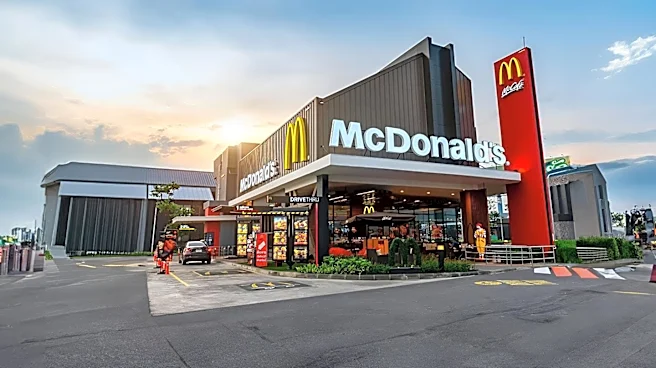
McDonald's drive-thru service is significantly faster than Burger King's, according to a 2026 report by Intouch Insight. The report, which evaluated 13 major fast-food brands, found that the average total time from entering the drive-thru line to receiving
an order was nearly 40 seconds shorter at McDonald's compared to Burger King. While both chains had similar wait times before ordering, McDonald's outperformed Burger King in service time, delivering orders an average of 32 seconds faster per visit. This speed difference is notable, with McDonald's averaging four minutes and 38 seconds per car, while Burger King averaged seven minutes and 44 seconds. Burger King has been working to improve its operations through its 2022 'Reclaim the Flame' initiative, which has led to increased sales and the chain surpassing Wendy's as the second-largest burger chain in the country in 2026.
Why It's Important?
The disparity in drive-thru speed between McDonald's and Burger King has significant implications for customer satisfaction and competitive positioning within the fast-food industry. In a market where convenience and speed are paramount, McDonald's efficiency gives it a distinct advantage in attracting and retaining customers. For Burger King, despite its recent successes in sales growth and market share against Wendy's, the slower drive-thru service could hinder its ability to effectively compete with McDonald's. This operational bottleneck can lead to longer queues, potentially deterring time-sensitive customers and impacting overall brand perception. The 'Reclaim the Flame' initiative's focus on operational improvements highlights Burger King's recognition of these challenges, but the drive-thru speed gap indicates that further enhancements are needed to match McDonald's operational prowess.
What's Next?
Burger King will likely continue to focus on operational efficiencies, particularly in its drive-thru service, to narrow the gap with McDonald's. The success of its 'Reclaim the Flame' initiative in boosting sales and market position against Wendy's suggests a commitment to improvement. Future strategies may involve optimizing order processing, enhancing staff training, or implementing new technologies to expedite service times. McDonald's, in turn, will likely seek to maintain its operational lead, potentially exploring further innovations in its drive-thru system to solidify its competitive advantage. The ongoing competition between these fast-food giants will continue to drive advancements in customer service and operational efficiency across the industry.
Beyond the Headlines
The drive-thru speed differential between McDonald's and Burger King underscores a broader trend in the fast-food industry: the increasing importance of operational excellence as a key differentiator. Beyond menu innovation and marketing, the ability to deliver a quick and seamless customer experience is becoming critical for market leadership. This focus on efficiency reflects evolving consumer expectations for instant gratification and convenience, particularly in the post-pandemic landscape where drive-thrus have become even more central to fast-food operations. The data also suggests that even with successful brand revitalization efforts, fundamental operational aspects like service speed can significantly influence a company's competitive standing and long-term growth potential.