



What's Happening?
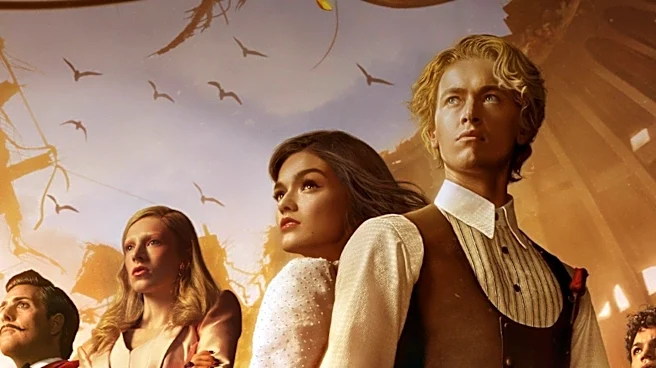
Nina Jacobson, a producer for 'The Hunger Games' franchise, has stated that if given the opportunity to adapt Suzanne Collins's novel 'Mockingjay' again, she and director Francis Lawrence would likely combine it into a single movie. The final book in the series
was famously split into two films, 'Mockingjay – Part 1' (2014) and 'Mockingjay – Part 2' (2015). Both films received lower critical and audience scores compared to the first two 'Hunger Games' installments, with 'Part 1' often criticized for feeling drawn out. Jacobson acknowledged that while the intention was to fully tell the story, audiences perceived the split as a cynical move to generate more ticket sales. She emphasized a current commitment to transforming even large books into tight, theatrical experiences without exploiting audience patience.
Why It's Important?
This admission from a key producer highlights a significant trend in Hollywood, particularly within major fantasy and young adult franchises, where final books are often split into multiple films. This practice, previously seen with 'Harry Potter and the Deathly Hallows' and 'Twilight: Breaking Dawn,' has frequently been criticized by fans and critics as a commercial decision rather than an artistic one. Jacobson's statement validates these long-standing audience perceptions, acknowledging that such splits can be viewed as cynical, even if the creators' intentions were earnest. This self-reflection from a major studio figure could influence future adaptation strategies, potentially leading to a more cautious approach to splitting source material, prioritizing narrative integrity and audience experience over maximizing box office returns through multiple releases.
What's Next?
Jacobson's comments may prompt other producers and studios to re-evaluate their strategies for adapting popular book series, especially those with dedicated fan bases. While the 'Mockingjay' films were financially successful, grossing $775 million for Part 1 and $653 million for Part 2, the creative critique from within the production team could lead to a shift in industry practices. Future adaptations of lengthy novels might face increased scrutiny regarding single-film versus multi-film approaches. This could result in more condensed and focused cinematic narratives, aiming to avoid the perception of 'spinning wheels' that plagued 'Mockingjay – Part 1.' The success of the new film, 'Sunrise on the Reaping,' which grossed $120 million in its opening weekend, suggests a renewed focus on strong, singular narratives could benefit the franchise.
Beyond the Headlines
The debate over splitting final books into multiple films extends beyond mere financial considerations; it touches upon the artistic integrity of adaptations and the relationship between creators and their audience. When a producer admits that a decision, even if well-intentioned, was perceived as cynical, it reflects a broader industry challenge: balancing commercial viability with creative fidelity. This situation also underscores the power of audience perception and how it can shape the narrative around a film franchise. The 'Mockingjay' split, while profitable, ultimately left a creative stain that even years later, producers are reflecting upon. This ongoing dialogue about adaptation choices highlights the evolving standards and expectations within the film industry regarding how beloved literary works are brought to the screen, emphasizing the importance of respecting both the source material and the audience's investment.