





What's Happening?
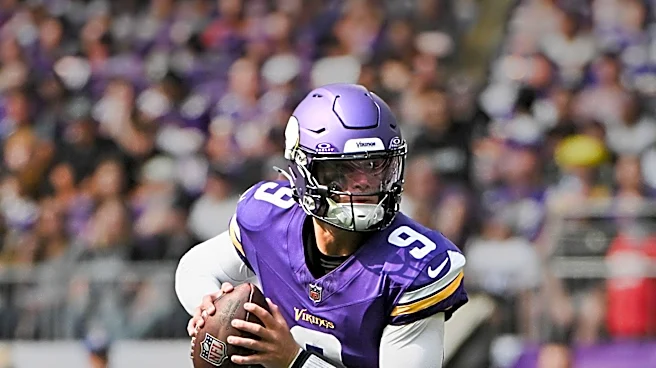
The Minnesota Vikings' acquisition of Kirk Cousins before the 2026 NFL trade deadline has significant implications for former Arizona Cardinals quarterback Kyler Murray, according to The Arizona Republic's Bob McManaman. This trade is also affecting the playoff
prospects of NFC West teams like the Seattle Seahawks and Los Angeles Rams. Currently, if the NFL playoffs were to start, all four teams in the NFC North—the Chicago Bears (7-2), Detroit Lions (6-2), Minnesota Vikings (6-2), and Green Bay Packers (6-3)—would qualify for the postseason. This scenario, where all four teams from a single division make the playoffs, has not occurred since the league adopted its current alignment in 2002. The Seahawks (5-4) and Rams (5-4) would miss out, sitting at the No. 8 and No. 9 NFC positions, respectively.
Why It's Important?
The trade of Kirk Cousins to the Vikings has reshaped the competitive landscape of the NFC, particularly for playoff contention. For Kyler Murray, this move signals a potential downturn in his career trajectory, as the Vikings' commitment to Cousins suggests a reduced market for other quarterbacks. The NFC North's dominance, with all four teams currently projected to make the playoffs, highlights a rare and intense divisional competition. This situation could lead to a historical first for the NFL's current playoff format, demonstrating how a single player trade can ripple through multiple teams and divisions. The Seahawks and Rams, despite their respectable records, are now facing a tougher path to the postseason due to the strengthened NFC North, underscoring the high stakes of mid-season trades and their impact on conference-wide dynamics.
What's Next?
The remainder of the NFL season will determine if the NFC North can maintain its unprecedented playoff dominance. While NFC North teams will face each other, potentially leading to attrition, the Seahawks and Rams also have challenging schedules ahead. The Vikings' remaining games include matchups against the Packers, 49ers, Patriots, Lions, and Bears. The Packers will play the Vikings, Rams, Bills, Bears, and Lions. The Lions have games against the Patriots, Bears (twice), Vikings, and Packers. The Bears will face the Lions (twice), Jaguars, Bills, Packers, and Vikings. The Seahawks' schedule includes the 49ers, Giants, and Rams (twice), while the Rams will play the Packers, Chiefs, 49ers, and Seahawks (twice). The playoff probabilities, as listed by NFL.com, show the 49ers at 94%, Bears at 84%, Lions at 83%, Vikings at 74%, and Packers at 63%, with the Seahawks at 49% and Rams at 45%.
Beyond the Headlines
This development raises questions about the NFL's current playoff system and whether it adequately balances divisional strength with overall conference competitiveness. If all four teams from one division consistently make the playoffs, it could spark debates about potential adjustments to ensure broader representation across the conference. The intense competition within the NFC North could also lead to a more physically demanding season for those teams, potentially affecting their performance in the later stages of the playoffs. Furthermore, the impact on player valuations, particularly for quarterbacks like Kyler Murray, demonstrates how team decisions can significantly alter individual career paths and market dynamics within the league. The scenario underscores the strategic importance of trades and their long-term consequences for both teams and players.