



What's Happening?
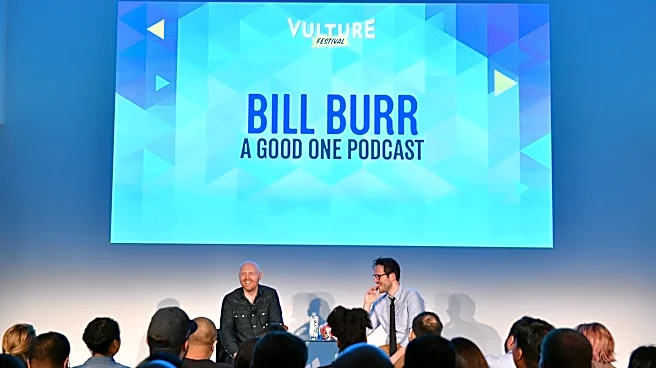
Comedian and actor Bill Burr recently stated that he no longer watches round-the-clock news coverage, attributing his decision to the anxiety it causes him. During an appearance on the 'Listen & Laugh' podcast hosted by Ice Cube and Mike Epps, Burr explained
that he hasn't watched the news in a significant amount of time. He articulated his belief that contemporary news lacks genuine journalism, describing it as 'just two channels pointing at each other, making us all mad at each other and there's no solutions.' Burr also humorously noted that he can often discern if someone is a constant consumer of 24-hour news by their stressed demeanor. He further suggested that news platforms intentionally 'scare the shit out of people' and manipulate public focus, citing the 2020 global pandemic as an example where a man hoarding hand sanitizer received widespread criticism.
Why It's Important?
Burr's comments highlight a growing sentiment among some members of the public regarding the perceived state of modern journalism and its impact on mental well-being. His perspective, shared by a public figure, could resonate with individuals who feel overwhelmed or anxious by the constant news cycle and its often confrontational presentation. This sentiment can contribute to a broader distrust in media institutions and a potential disengagement from traditional news sources. For the media industry, such criticisms from influential voices like Burr underscore the challenges in maintaining public trust and delivering news in a way that informs without causing undue distress. It also raises questions about the long-term effects of sensationalism and partisan reporting on societal discourse and individual mental health.
What's Next?
While Burr's statements are personal observations, they contribute to an ongoing public conversation about media consumption habits and the role of news in society. It is unlikely to lead to immediate policy changes within news organizations, but it may encourage further discussion among media critics, mental health professionals, and the general public about responsible journalism and media literacy. Individuals may increasingly seek alternative news sources or adopt strategies to limit their exposure to what they perceive as anxiety-inducing content. This trend could prompt some news outlets to re-evaluate their content strategies, potentially exploring more solution-oriented or less confrontational reporting styles to cater to a segment of the audience that shares Burr's concerns.
Beyond the Headlines
Burr's remarks touch upon deeper societal implications concerning the intersection of media, mental health, and public discourse. The idea that news platforms 'scare the shit out of people' and manipulate focus suggests a potential ethical dilemma for media organizations. If the primary goal becomes audience engagement through emotional arousal rather than objective reporting, it could erode the foundational principles of journalism. This could lead to a more polarized society, where citizens are less informed by nuanced facts and more driven by emotional reactions. The long-term consequence might be a decline in critical thinking and an increased susceptibility to misinformation, as individuals may struggle to differentiate between factual reporting and emotionally charged narratives designed to provoke a response.