






What's Happening?
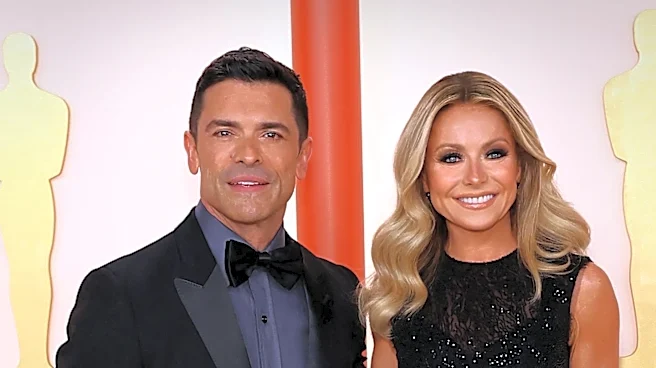
During an episode of 'Live with Kelly and Mark,' Kelly Ripa addressed the concept of 'mankeeping,' which she defined as women disproportionately handling the emotional and organizational needs of their male partners. Ripa highlighted her own experiences,
stating that she is responsible for tasks such as organizing holidays, purchasing gifts, and writing all family cards. She emphasized that without her efforts, significant family events like birthdays and holidays would not occur. Her husband, Mark Consuelos, acknowledged her role in these tasks. Ripa expressed that this imbalance is unhealthy and unsustainable for women, advocating for greater equality in partnerships regarding household and emotional labor. While she clarified that she does not manage Consuelos' social life, she underscored the broader issue of women often taking on the role of 'social secretary' for their husbands.
Why It's Important?
The discussion around 'mankeeping' is important as it sheds light on the often-invisible emotional and organizational labor predominantly performed by women in relationships and households. This unequal distribution of tasks can lead to burnout and stress for women, impacting their well-being and potentially hindering their professional and personal development. The conversation, particularly from a high-profile couple like Kelly Ripa and Mark Consuelos, brings mainstream attention to gender dynamics within domestic partnerships. It encourages a broader societal dialogue about shared responsibilities and the need for more equitable partnerships, which can influence cultural norms and expectations regarding gender roles in the home. Addressing these imbalances can foster healthier relationships and contribute to a more balanced societal structure where both partners contribute equally to the emotional and logistical upkeep of family life.
What's Next?
Following Kelly Ripa's public discussion, Mark Consuelos offered to take over the responsibility of handling cards, indicating a potential shift towards more shared domestic duties within their own household. This public acknowledgment and proposed action could serve as a model for other couples to re-evaluate and redistribute their own household and emotional labor. The ongoing dialogue around 'mankeeping' is likely to continue, potentially inspiring more conversations in media and among individuals about the importance of equitable partnerships. This could lead to increased awareness and efforts to challenge traditional gender roles, encouraging men to take on a more active and equal share of domestic responsibilities, thereby promoting healthier and more balanced relationships.
Beyond the Headlines
The concept of 'mankeeping' extends beyond individual households and touches upon broader societal implications regarding gender equality. The disproportionate burden of emotional labor on women can contribute to systemic issues, such as the 'gender pay gap' and women's slower career progression, as they often expend significant energy on unpaid domestic and emotional work. This phenomenon can also perpetuate traditional gender stereotypes, where women are expected to be the primary caregivers and emotional support systems. By highlighting 'mankeeping,' Ripa's comments implicitly challenge these ingrained societal expectations, advocating for a cultural shift where emotional and organizational labor is recognized as valuable and shared equitably. This deeper examination can lead to a re-evaluation of societal structures that inadvertently reinforce these imbalances, promoting a more just and equitable distribution of responsibilities in all spheres of life.