



What's Happening?
Nissan North America is significantly shifting its strategy towards hybrid vehicles, aiming for hybrids to become the primary powertrain in North America by 2030. This marks a departure from its previous focus on fully electric vehicles (EVs) and a historical
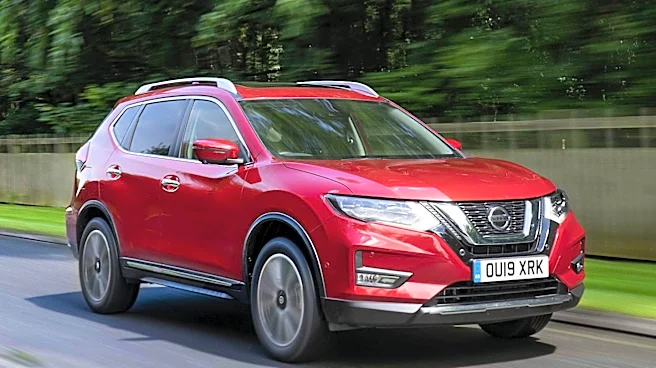
underemphasis on hybrids. The company plans to introduce a Rogue e-Power hybrid for the 2027 model year, with Nissan Americas Chair Christian Meunier expecting it to quickly account for 30 to 40 percent of Rogue sales. The initial Rogue hybrids will be imported from Japan, with gas Rogue production starting next summer and hybrid assembly commencing in Smyrna, Tennessee, in early 2028. This move could lead to an additional shift and bring the Smyrna plant to its full capacity of 600,000 vehicles annually, up from its current 400,000. Nissan's e-Power system, a series hybrid, differs from the more common parallel hybrids by using the gasoline engine solely as a generator for the electric motors that power the wheels. The third generation of this e-Power system has been optimized for North American driving patterns, including sustained highway driving and high fuel efficiency, featuring a new 1.5L turbocharged engine and delivering 225 hp with all-wheel drive.
Why It's Important?
This strategic pivot by Nissan is significant for the U.S. automotive market, indicating a broader industry trend towards hybrid technology as a bridge to full electrification. Nissan's commitment to making hybrids its primary powertrain by 2030 suggests a recognition that consumer adoption of EVs may be slower than initially anticipated, or that hybrids offer a more immediate and practical solution for emissions reduction and fuel efficiency. The planned assembly of Rogue hybrids in Smyrna, Tennessee, could create new manufacturing jobs and boost the local economy, bringing the plant to full capacity. This move also intensifies competition within the hybrid SUV segment, challenging established players like Toyota and Honda. For consumers, it means more hybrid options with potentially advanced technology optimized for North American driving conditions, offering improved fuel economy and performance. The shift away from plug-in hybrids, as evidenced by the discontinuation of the rebadged Mitsubishi Outlander PHEV due to low sales, highlights the current market preference for conventional hybrids in the U.S.
What's Next?
The immediate next step for Nissan is the launch of the Rogue e-Power hybrid for the 2027 model year, with a strong push to capture a significant portion of Rogue sales. Following this, the company will focus on establishing hybrid assembly operations at its Smyrna, Tennessee plant by early 2028, which could lead to increased production capacity and job creation. Nissan also plans to expand its hybrid offerings across its SUV and pickup lineup, with an Xterra hybrid confirmed and a Kicks e-Power hybrid expected by 2028. This aggressive hybrid rollout will likely be accompanied by marketing campaigns emphasizing the benefits of their e-Power system, particularly its optimization for North American driving. The success of these new hybrid models will be crucial for Nissan's market share and financial performance in the coming years, as it aims to catch up with competitors in the hybrid segment.
Beyond the Headlines
Nissan's renewed focus on hybrids reflects a deeper industry re-evaluation of electrification strategies. While many automakers initially prioritized full EVs, the challenges of charging infrastructure, battery costs, and consumer range anxiety have made hybrids a more appealing interim solution. This shift could influence public policy discussions around emissions standards and incentives, potentially leading to greater support for hybrid technologies. Ethically, it raises questions about the environmental impact of continued reliance on internal combustion engines, even in hybrid form, versus a faster transition to full EVs. Culturally, it signifies a potential recalibration of consumer expectations regarding vehicle technology, where practicality and immediate fuel savings might outweigh the long-term environmental benefits of pure EVs for a significant portion of the market. This move also highlights the importance of regional market differences, as Nissan's e-Power system was initially designed for urban areas in other continents before being adapted for North America.