





What's Happening?
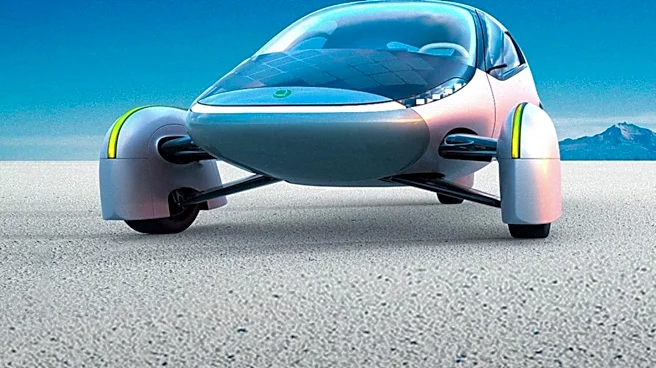
Aptera, a company known for its innovative solar-powered vehicles, has recently demonstrated the solar generation capabilities of its latest model. The vehicle, equipped with built-in solar cells, was able to recharge itself, achieving a peak of 4.6 kilowatt-hours
by repositioning to maximize sun exposure. This milestone confirms the effectiveness of Aptera's curved solar panels and custom charge controller. However, the company now faces the challenge of proving the vehicle's efficiency. To meet its goal of providing 40 miles of daily solar range, the vehicle must achieve an efficiency of 100 watt-hours per mile, translating to 10 miles per kilowatt-hour. This is significantly higher than the 3 to 4.5 miles per kilowatt-hour typical of most electric vehicles. Aptera's design, which includes a lightweight structure and aerodynamic shape, is crucial to achieving this efficiency.
Why It's Important?
The success of Aptera's solar-powered vehicle could significantly impact the electric vehicle (EV) market by offering a solution for those without access to home charging. The ability to charge a vehicle using solar power while parked could reduce reliance on expensive and inconvenient DC fast charging. This innovation could make EV ownership more accessible and appealing, particularly for urban dwellers who park on the street or in apartment complexes. If Aptera can prove its efficiency claims, it could redefine expectations for EV performance and sustainability, potentially accelerating the adoption of solar-powered vehicles and reducing the carbon footprint of personal transportation.
What's Next?
Aptera plans to conduct a third-party validation sequence in July to test the vehicle's efficiency claims. This will include a full range test, driving the vehicle from a fully charged state to zero percent battery to confirm real-world efficiency. If successful, Aptera will have demonstrated a significant advancement in solar-powered transportation, potentially influencing future EV designs and encouraging further investment in solar technology for vehicles. The outcome of these tests will be closely watched by industry stakeholders and could lead to increased interest and investment in similar technologies.