







What's Happening?
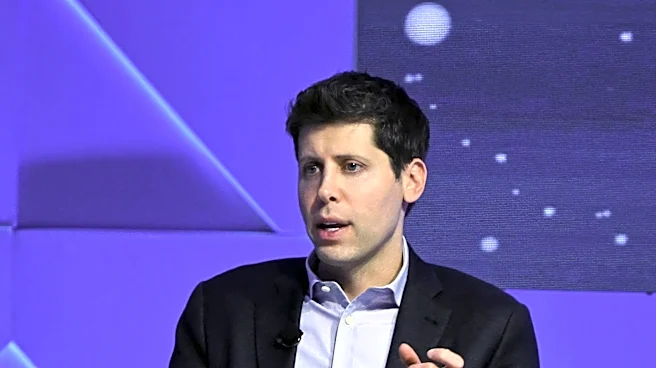
Sam Altman, CEO of OpenAI, has acknowledged that he and other industry leaders were overly ambitious regarding the speed of AI adoption and its impact on the economy. He initially expected significant disruption and a rapid shift in software businesses
following the launch of GPT-4 in 2023. However, this transformation has not occurred at the predicted pace. Altman attributes this slower adoption to the inherent inertia of the economy, where individuals and businesses tend to maintain existing habits, purchasing patterns, and tool usage. He views this slower transition as potentially beneficial, allowing society and businesses more time to integrate AI into daily operations rather than forcing rapid, potentially disruptive changes. Altman's comments align with some other AI industry figures, like Microsoft AI chief Mustafa Suleyman, who also note the difficulty of definitive predictions regarding Artificial General Intelligence (AGI).
Why It's Important?
This admission from a leading figure in the AI industry highlights a crucial disconnect between technological advancement and real-world integration. While AI capabilities are rapidly evolving, the pace of societal and economic adaptation is considerably slower. This 'inertia' can impact investment strategies, product development cycles, and workforce planning across various U.S. industries. Businesses that anticipated immediate, widespread AI-driven disruption may need to recalibrate their strategies, focusing more on gradual integration and user-centric adoption rather than rapid overhauls. The slower pace could also provide a window for policymakers to develop regulatory frameworks and address potential societal impacts, such as job displacement, more thoughtfully. Conversely, companies that can effectively bridge the gap between advanced AI and practical, user-friendly applications stand to gain significantly, as the market is clearly seeking solutions that fit seamlessly into existing workflows.
What's Next?
In the immediate future, OpenAI and other AI developers may shift their focus from solely pushing technological boundaries to also addressing the practical challenges of integration and user adoption. This could involve developing more intuitive interfaces, providing extensive training and support, and demonstrating clear, tangible benefits for businesses and individuals. Altman's perspective suggests a more measured approach to AI deployment, which might lead to a greater emphasis on specialized AI tools that solve specific problems rather than broad, general-purpose AI. Furthermore, the industry might see increased collaboration between AI developers and businesses to tailor solutions that overcome existing inertia. The ongoing dialogue about AI's pace of adoption will likely influence future research directions, funding allocations, and public discourse surrounding the technology's role in society.
Beyond the Headlines
The slower-than-expected adoption of AI, despite its rapid technological progress, reveals deeper insights into human behavior and organizational change. It underscores that even revolutionary technologies face significant hurdles when confronting established routines, trust in existing vendors, and the sheer effort required to retrain employees and integrate new systems. This inertia acts as a powerful, often underestimated, 'moat' for incumbent businesses, allowing them time to adapt rather than being immediately disrupted by technologically superior startups. Ethically, this slower pace offers a crucial opportunity to consider the broader societal implications of AI, including job security, data privacy, and the potential for centralized AI power, which Altman himself has expressed concerns about. The challenge extends beyond technical innovation to understanding and managing the complex interplay between technology, human psychology, and economic systems.