





What's Happening?
Lenders involved in a $43 billion debt deal for Elon Musk-led Space Exploration Technologies Corp. (SpaceX) are reportedly attempting to prevent the company from launching valuable Nvidia Corp. AI chips into space. The Financial Times reported that lenders
fear they may not be able to recover or resell these semiconductors if SpaceX deploys them in orbit and subsequently defaults on its loans. This dispute centers on "Project Saturn," a financing package that includes over $30 billion in debt sold to institutional investors. A significant portion, $25 billion, consists of investment-grade bonds backed by SpaceX's five-year chip lease payments. While SpaceX asserts that the financed chips will operate on Earth, it remains unclear whether lenders have successfully secured the proposed restriction against orbital deployment. The bonds offered yields near 8.3%, higher than SpaceX's existing debt, and the principal is set to be repaid within four years to mitigate creditor exposure.
Why It's Important?
This situation highlights increasing scrutiny in AI-related borrowing and the complexities of financing high-tech ventures with unique operational risks. Lenders' concerns about collateral recovery underscore a fundamental principle of secured lending: the ability to seize and liquidate assets in case of default. If valuable AI chips are launched into space, their recovery becomes logistically challenging and potentially impossible, significantly increasing the risk for creditors. This could set a precedent for future financing deals in the aerospace and advanced technology sectors, potentially leading to more stringent collateral requirements or higher borrowing costs for companies planning orbital deployments of expensive equipment. The dispute also reflects a broader trend of lenders becoming more selective in AI-related financing, as projected by Goldman Sachs Research, which anticipates hyperscaler debt issuance reaching $420 billion by 2027.
What's Next?
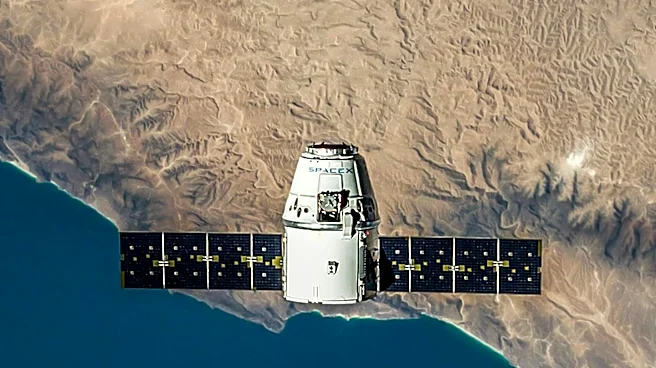
The immediate next step involves clarifying whether lenders will successfully impose the restriction on SpaceX's use of the Nvidia chips. The outcome of these discussions could influence the terms of future financing for SpaceX and other companies engaged in space-based technology development. SpaceX has not yet publicly responded to these reports, and its stance on the proposed restrictions will be crucial. The resolution of this dispute could also impact Musk's previously stated ambitions to launch Nvidia-powered computers into orbit by 2027, which he suggested could reduce reliance on terrestrial cooling infrastructure. The broader financial market will likely monitor this situation closely as it could shape lending practices for innovative, high-risk technology projects.
Beyond the Headlines
Beyond the immediate financial implications, this dispute touches upon the evolving legal and regulatory frameworks surrounding assets in space. As more commercial entities venture into space with advanced technology, questions of ownership, collateral, and recovery in the event of financial distress become increasingly pertinent. The concept of 'orbital collateral' presents novel challenges for traditional financial instruments and legal precedents. This situation could spur discussions among policymakers and financial regulators about developing new guidelines or insurance mechanisms to address the unique risks associated with financing space-based assets. It also underscores the tension between ambitious technological innovation and the conservative nature of financial risk management, particularly when dealing with assets that operate beyond conventional terrestrial jurisdiction.