



What's Happening?
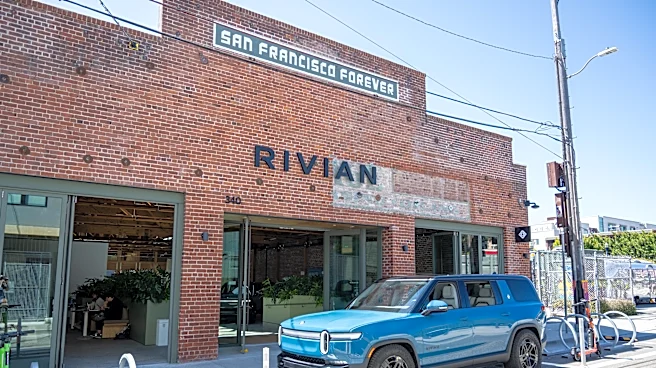
Rivian Automotive has provided comprehensive guidance for its electric vehicle (EV) owners on selecting and installing home charging solutions. The company emphasizes that the optimal charger depends on individual driving habits, vehicle models, and home electrical
systems. Rivian offers two primary home charging options: the hardwired Wall Charger and the Portable Charger. The Wall Charger delivers up to 48 amps (11.5 kW) on a dedicated 60A circuit, adding up to 25 miles of range per hour for R1T and R1S models, and 38 miles per hour for R2 models. The Portable Charger provides up to 32 amps (7.6 kW) on a 240-volt connection, offering flexibility with NEMA 5-15 and NEMA 14-50 adapters. Rivian's 2026 and newer models will utilize the NACS connector, while 2022-2025 R1T and R1S models use a CCS1 inlet with J1772 for AC charging. The company also highlights features like Wi-Fi connectivity for automatic software updates and Smart Charging to optimize charging times based on local utility rates.
Why It's Important?
The detailed guidance from Rivian Automotive on home EV charging is crucial for accelerating EV adoption and enhancing the ownership experience in the U.S. As the EV market expands, accessible and efficient home charging infrastructure becomes a key factor for consumers. By providing clear information on charger types, installation considerations, and cost-saving measures, Rivian helps demystify a complex aspect of EV ownership. This initiative can reduce range anxiety and encourage more consumers to transition to electric vehicles, directly impacting the growth of the U.S. EV industry. Furthermore, the emphasis on smart charging and off-peak rate utilization can lead to significant cost savings for consumers and help manage grid demand, contributing to energy efficiency and sustainability goals across the nation.
What's Next?
Rivian's continued focus on home charging solutions suggests further integration of smart technologies and partnerships to streamline the installation process. The company's preferred installation partners, Qmerit and Treehouse, are expected to continue providing nationwide services, including virtual assessments and labor warranties, to simplify the setup for owners. As Rivian transitions to the NACS connector for its 2026 and newer models, the industry will likely see a broader standardization of charging infrastructure, potentially leading to more seamless charging experiences across different EV brands. Future developments may also include enhanced software features for energy management and more localized incentives for EV charger installations, driven by state and local programs and utility companies.
Beyond the Headlines
The detailed approach to home charging by Rivian Automotive reflects a broader industry trend towards holistic EV ecosystems that extend beyond just the vehicle. This focus on the 'last mile' of EV ownership—the daily charging experience—is critical for long-term customer satisfaction and brand loyalty. It also highlights the evolving role of automotive manufacturers as providers of energy solutions, not just vehicles. The integration of smart charging capabilities and partnerships with installation services underscores a shift towards a more interconnected and intelligent energy grid. This could lead to new business models and collaborations between EV manufacturers, utility companies, and smart home technology providers, ultimately shaping the future of energy consumption and infrastructure in the U.S.