


What's Happening?
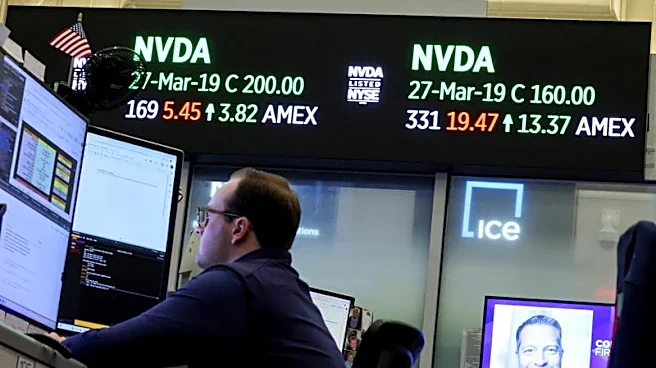
The US Dollar Index (DXY) has softened to approximately 103.70 in early European trading hours, declining as traders monitor equity markets for direction. This weakening is attributed to a sharp pullback in US technology and AI-related equities, which
has triggered heightened volatility and concerns about a potential AI slowdown impacting US growth. Despite this, the US Dollar has generally strengthened amidst a broader sell-off in US stocks and a pullback in US yields from year-to-date highs. Analysts at MUFG/BTMU note that this weakness in the US equity market is occurring alongside strengthening cyclical growth momentum in the US, a combination that typically encourages a stronger US dollar. The Federal Reserve's monetary policy remains a primary influence on the dollar's value, with expectations for a 25 basis point interest rate hike in December providing some support for the currency.
Why It's Important?
The fluctuation of the US Dollar Index is significant for global financial markets and the US economy. A weaker dollar can make US exports more competitive but can also increase import costs and potentially fuel inflation. The current situation, where the dollar is weakening due to concerns in the technology sector but supported by expectations of Federal Reserve tightening, reflects a complex economic landscape. The performance of AI-related stocks is having a notable impact on market sentiment, indicating the growing influence of the technology sector on broader economic indicators. The Federal Reserve's ongoing efforts to manage inflation through interest rate adjustments remain a critical factor, as tighter monetary policy generally supports the dollar's value, even as equity market volatility introduces downward pressure.
What's Next?
Market participants will closely watch the performance of AI-related stocks to determine if the current downtrend will reverse, as this will likely influence the US Dollar's direction. The Federal Reserve's upcoming policy decisions, particularly regarding interest rates, will be crucial. Traders are anticipating a quarter-point interest rate hike in December, which could provide continued support for the dollar. However, the Fed will also be monitoring the impact of tightening financial conditions, including a stronger dollar and equity market weakness, on the need for further rate hikes. The balance between robust cyclical growth momentum and rapidly tightening financial conditions will be central to the dollar's trajectory and the Fed's evolving policy calculus.
Beyond the Headlines
The current market dynamics highlight the increasing interconnectedness between technological advancements, equity market performance, and currency valuations. The 'AI trade' has become a significant driver of market sentiment, and any perceived slowdown or correction in this sector can have ripple effects across the broader economy. This situation also underscores the Federal Reserve's delicate balancing act: aiming to achieve price stability and full employment while navigating external pressures from volatile equity markets and evolving technological trends. The long-term implications could include a re-evaluation of investment strategies heavily concentrated in tech, and a potential shift in how global investors perceive the stability of the US economy in the face of sector-specific downturns.