



What's Happening?
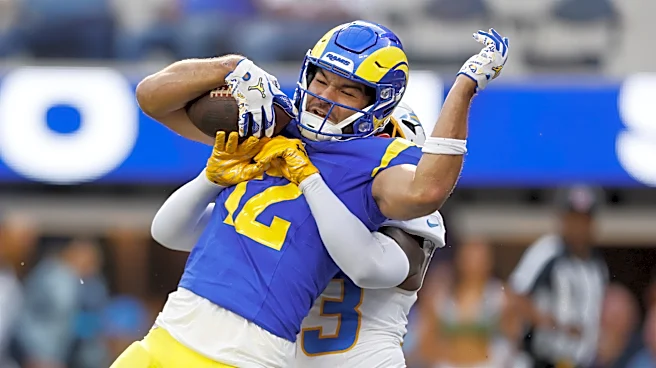
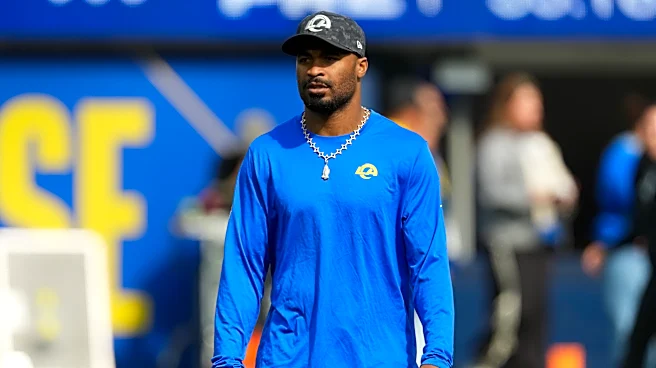
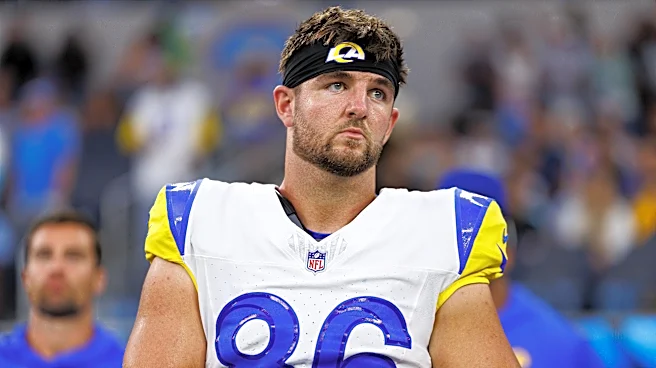
The Los Angeles Rams have executed a strategic financial maneuver by restructuring the contracts of running back Kyren Williams and safety Kamren Curl, generating $3 million in salary cap space. This action, reported by ESPN's Field Yates and Spotrac,
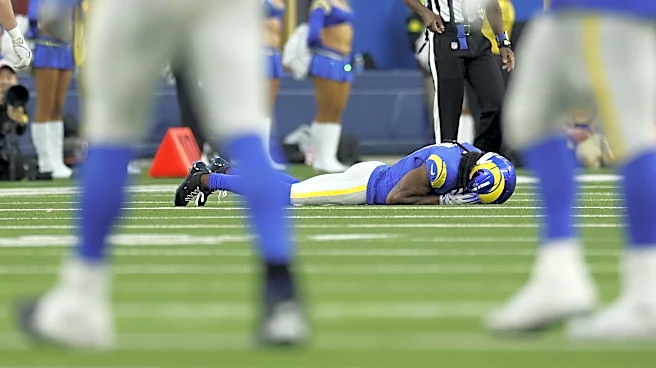
involved converting portions of their base salaries into signing bonuses and adding two void years to their contracts. Specifically, $2 million of Williams' base salary was converted, freeing up $1.7 million, while $1.7 million of Curl's base salary was converted, creating an additional $1.3 million. These restructures provide the Rams with crucial financial flexibility as they navigate the latter part of the NFL season, especially with key offensive players like Puka Nacua and Davante Adams sidelined due to injuries. General Manager Les Snead and Head Coach Sean McVay are known for their aggressive roster building, and this move aligns with their approach to managing the team's financial resources.
Why It's Important?
This financial strategy is significant for the Los Angeles Rams as it provides immediate cap relief, allowing them to manage their roster more effectively during a critical period. The team was previously operating with minimal cap space, at one point having less than $10,000 available and being approximately $600,000 over the cap. The newly acquired $3 million in cap space enables the Rams to make necessary roster adjustments, sign free agents, or cover practice squad elevations, which is particularly vital given their current injury woes. The ability to create cap space through contract restructures is a common but complex NFL financial tactic, demonstrating the team's commitment to maintaining a competitive roster despite financial constraints. This flexibility is crucial for teams aiming for a playoff push, as it allows them to address immediate needs without long-term financial repercussions that could hinder future seasons.
What's Next?
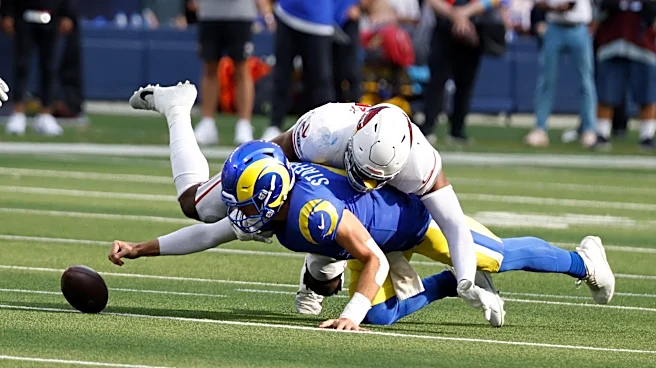
The immediate impact of this cap space will be felt as the Rams prepare for their Week 10 divisional game against the Arizona Cardinals. With star wideout Puka Nacua out with MCL and PCL sprains and veteran receiver Davante Adams on injured reserve, the team faces significant offensive challenges. The newly created cap room could be used to sign depth players or make other strategic moves to bolster the roster. Analysts are suggesting a potential evolution in the backfield, with calls for Kyren Williams and Blake Corum to be on the field together more frequently to compensate for the absence of key receivers. While void years in contracts eventually lead to 'dead money' hits when the contracts expire, this tactic grants Snead and McVay the necessary financial bandwidth for weekly roster management and potential late-season additions, indicating a focus on immediate competitive needs.
Beyond the Headlines
The use of 'void years' in NFL contracts, as seen in the Rams' recent restructures, highlights a sophisticated aspect of sports finance and the NFL's Collective Bargaining Agreement (CBA). Article 13 of the CBA allows teams to prorate signing bonuses over up to five years, and void years are essentially 'dummy years' designed to extend this proration period, thereby reducing the immediate cap hit. While this provides short-term financial flexibility, it creates future 'dead money' charges, which are cap hits for players no longer on the roster. This strategy reflects a calculated risk-reward approach, prioritizing immediate competitive advantage over future cap health. It also underscores the constant financial tightrope walk that NFL general managers and coaches navigate, balancing current performance with long-term sustainability, and the intricate mechanics of contract management in professional sports.