






What's Happening?
American Tungsten Corp. has filed a National Instrument 43-101 Technical Report concerning the updated Mineral Reserve and Mineral Resource estimate for its IMA Project located in Lemhi County, Idaho, USA. The report is accessible on the company's website
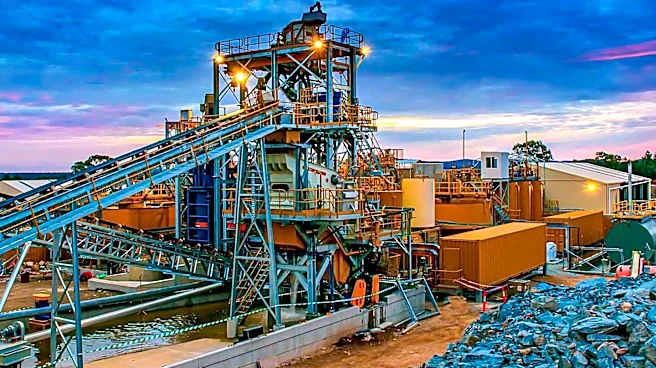
and through its SEDAR+ profile. The IMA Mine, a former underground tungsten producer, operated between 1945 and 1957, yielding approximately 199,449 MTUs of WO₃. Subsequent exploration for molybdenum and tungsten occurred from 1960 to 2010. The recently announced Mineral Resource Estimate for the IMA Mine includes 316,000 tonnes of Indicated Mineral Resources grading 0.55% WO₃, containing 1,747 tonnes of WO₃, and 2,178,000 tonnes of Inferred Mineral Resources grading 0.55% WO₃, containing 11,933 tonnes of WO₃. Additionally, a surface tailings resource contains 267,000 tonnes of Indicated Mineral Resources grading 0.15% WO₃, holding 413 tonnes of WO₃. This resource estimate supports American Tungsten's strategy to move the IMA Mine towards domestic tungsten production through a phased development approach.
Why It's Important?
The filing of this technical report is a significant step towards re-establishing domestic tungsten production in the United States. Tungsten is classified as a critical metal, essential for defense, industrial manufacturing, and advanced technologies. The reliance on foreign sources for such critical minerals poses national security and economic vulnerabilities. By advancing the IMA Mine project, American Tungsten aims to bolster North American supply-chain security, reducing dependence on international markets for this vital resource. This initiative could create jobs, stimulate local economies in Idaho, and contribute to the broader U.S. industrial base. The phased development approach, starting with the evaluation of existing surface tailings, offers a potentially lower-capital pathway to near-term production, which could accelerate the availability of domestically sourced tungsten. The long-term goal of restarting underground mining operations further solidifies the potential for a sustained domestic supply.
What's Next?
American Tungsten is currently engaged in an exploration drill program, advancing engineering and technical studies, and assessing the feasibility of restarting underground tungsten mining operations at the IMA Mine. The company's strategy involves a two-phase development. Phase I focuses on evaluating and potentially processing existing surface tailings, which is intended to provide a lower-capital route to potential near-term production. Phase II will concentrate on the rehabilitation and potential restart of the historic underground mine, leveraging the site's existing infrastructure and historical production data. These ongoing activities are crucial for determining the economic viability and operational timeline for the mine's return to production. Future announcements are expected regarding the progress of these studies and exploration efforts, which will further clarify the path to domestic tungsten supply.
Beyond the Headlines
The re-establishment of domestic tungsten production, as pursued by American Tungsten, has broader implications beyond immediate economic benefits. It addresses a critical aspect of national security by securing a reliable supply of a strategic mineral. Tungsten's use in defense applications, such as armor-piercing ammunition and missile components, makes its domestic availability paramount. Furthermore, its role in advanced technologies, including electronics and aerospace, underscores its importance for technological independence and innovation. This effort aligns with broader U.S. government initiatives to reduce reliance on foreign supply chains for critical materials, mitigating geopolitical risks and ensuring industrial resilience. The project also highlights the potential for revitalizing historical mining sites, balancing economic development with environmental considerations through modern mining practices and resource management.