







What's Happening?
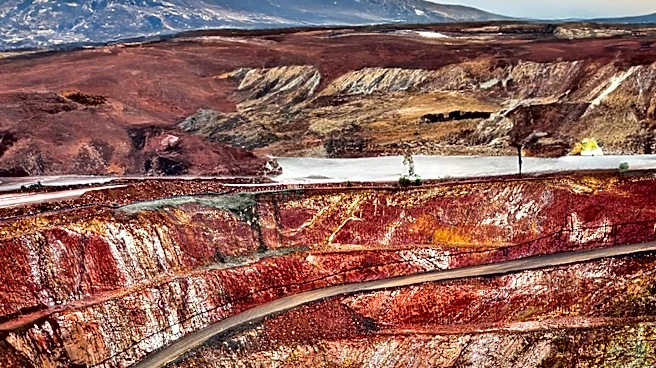
Edge Copper has announced significant progress in its Zonia Copper Project located in Arizona, USA. The company reported broad infill copper intercepts from nine additional diamond drill holes, reinforcing the continuity of the oxide system. Notable results
include a 697-foot intercept at 0.28% copper, with a higher-grade section of 170 feet at 0.47% copper. Another significant intercept was 544 feet at 0.27% copper from the surface, including 199 feet at 0.40% copper. As the infill program progresses, Edge Copper is transitioning to perimeter drilling to explore the deposit's extents, which remain open in all directions. The mineralized porphyry is now understood to be within a fault-bounded structural block, with the Eastern and Western faults defining its margins. The company plans to release initial assay results from drilling into the sulfide zone beneath the oxide deposit later in July, alongside commencing metallurgical test work.
Why It's Important?
The Zonia Copper Project is a significant development for Edge Copper, as it represents a strategic effort to expand copper resources in the United States. The project's success could bolster domestic copper supply, which is crucial given the increasing demand for copper in renewable energy technologies and electric vehicles. The continuity and grade of the oxide system confirmed by the infill drilling results enhance the project's viability and potential economic returns. This development is particularly relevant as the U.S. seeks to reduce its reliance on imported minerals and strengthen its supply chain for critical materials. Stakeholders in the mining industry, as well as policymakers focused on resource independence, stand to benefit from the project's advancement.
What's Next?
Edge Copper is set to continue its exploration efforts with perimeter drilling to define the full extent of the Zonia deposit. The upcoming assay results from the sulfide zone and the commencement of metallurgical test work will provide further insights into the project's potential. These steps are crucial for determining the feasibility of expanding the operation and potentially transitioning from exploration to production. The outcomes of these activities will likely influence investment decisions and strategic planning for the company. Additionally, the results could attract interest from larger mining companies or investors looking to capitalize on the growing demand for copper.