
What's Happening?
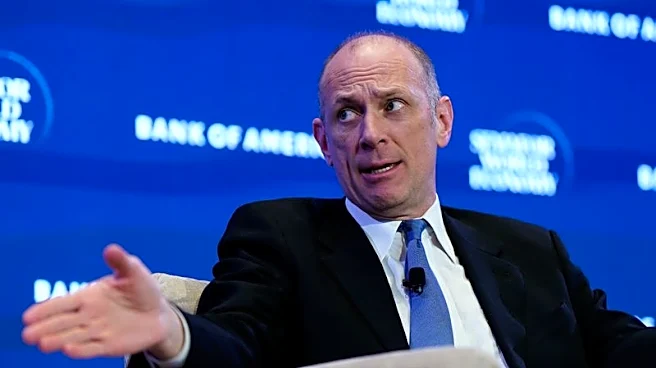
Federal Reserve Governor Lisa D. Cook has articulated a dual perspective on artificial intelligence's impact on the U.S. economy. Speaking at Oakland Tech Week on September 28, 2026, Cook stated that while
AI is expected to foster long-term economic growth and higher living standards, the substantial investment required for its development is currently contributing to inflationary pressures. She highlighted that the massive capital expenditures in AI, particularly in physical infrastructure like data centers and semiconductor manufacturing, demand significant resources such as electricity, materials, and skilled labor. These demands are driving up prices in sectors like electricity and construction labor by approximately 5%, exceeding the Federal Reserve's 2% inflation target. Cook's concerns about inflation are not new; she dissented from the Federal Open Market Committee’s October 2026 decision to maintain interest rates, citing ongoing inflation risks linked to AI. She reiterated these concerns in a November 20, 2026, speech, emphasizing that the projected $2 trillion in AI-related capital spending is largely yet to be deployed.
Why It's Important?
Governor Cook's assessment is significant because it signals the Federal Reserve's awareness of a potential timing mismatch: immediate inflationary costs versus delayed productivity benefits from AI. This perspective could influence future monetary policy decisions, potentially leading to higher interest rates for longer than markets anticipate if inflation remains elevated due to AI investments. For U.S. industries, this means that while AI promises transformative growth, the short-term economic environment may be characterized by increased costs and tighter monetary conditions. Businesses heavily investing in AI infrastructure, such as tech, manufacturing, utilities, and construction, will face rising expenses for labor, materials, and energy. Investors will need to navigate this 'awkward middle phase,' balancing the long-term growth potential of AI with the short-term risks of persistent inflation and potentially higher borrowing costs. The Fed's acknowledgment of AI as an inflation driver underscores its broad economic impact, moving it beyond a purely technological narrative into a critical factor in national economic stability.
What's Next?
The Federal Reserve will likely continue to closely monitor inflation data, particularly price pressures in sectors heavily influenced by AI infrastructure development, such as energy and construction. Governor Cook's stance suggests a potential for continued hawkish sentiment within the Fed, which could translate into a reluctance to lower interest rates prematurely or even a consideration for further rate hikes if inflation persists. Businesses and investors should prepare for a sustained period of elevated interest rates as the economy absorbs the costs of AI buildout before realizing its full productivity gains. The projected $2 trillion in AI capital spending will continue to reshape various sectors, leading to increased demand for resources and potentially sustained price pressures. Future Federal Reserve policy decisions will likely reflect this ongoing tension between the long-term economic promise of AI and its immediate inflationary consequences, with a focus on managing the timing gap between investment and measurable productivity improvements.
Beyond the Headlines
The deeper implication of Governor Cook's analysis lies in the challenge it poses to conventional economic forecasting and policy responses during periods of rapid technological advancement. The 'timing gap' between investment and productivity gains highlights a structural shift where significant capital is deployed upfront for future benefits, creating immediate economic friction. This scenario could lead to a prolonged period where the economy experiences the costs of innovation (inflation, labor market adjustments) before fully reaping its rewards (increased productivity, higher living standards). Ethically, this raises questions about equitable distribution of the short-term economic burden versus the long-term benefits, as certain sectors and demographics may feel the inflationary pinch more acutely. Legally and culturally, the massive investment in AI infrastructure could prompt new regulatory considerations regarding resource allocation, energy consumption, and labor market protections as automation advances. This development signals a potential long-term shift in how central banks evaluate technological booms, moving beyond simple growth projections to a more nuanced understanding of their immediate economic ripple effects.