







What's Happening?
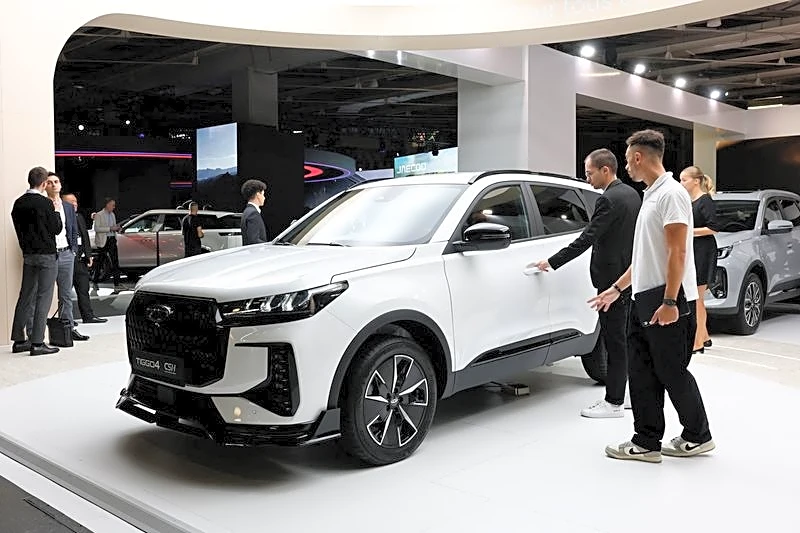
Chery, a major Chinese automotive exporter, is actively seeking a partnership with U.S. automakers to enter the American market, despite significant resistance from Detroit and Washington. The company's Vice President, Charlie Zhang, expressed openness
to various options, including collaborations with American manufacturers, and stated Chery's ability to engineer 'China-free' hardware and software solutions to comply with U.S. regulations. Currently, the U.S. imposes a 100-percent tariff on imported Chinese vehicles and bans Chinese vehicle software, particularly through the Connected Vehicle Rule, which blocks sales of connected vehicles and software with ties to China and Russia starting with the 2027 model year. U.S. industry groups, including manufacturers, dealers, and suppliers, along with numerous Democratic lawmakers, are urging the government to maintain these restrictions, citing concerns about unfair competition and national security.
Why It's Important?
The push by Chery to enter the U.S. market, and Detroit's unified opposition, highlights a critical juncture for the American automotive industry and trade policy. Chinese automakers, facing intense price wars and squeezed profit margins at home, view the U.S. as a lucrative market. However, U.S. industry leaders and policymakers are concerned about the potential for Chinese brands to 'dump' vehicles and overwhelm the domestic market, similar to what has been observed in Europe where Chinese market share has rapidly grown. This situation raises significant questions about fair competition, national security implications of connected vehicle technology, and the future of American manufacturing jobs. The outcome of Chery's efforts and the U.S. response will have profound implications for consumer choices, industry competitiveness, and international trade relations.
What's Next?
The immediate future will likely see continued efforts by Chinese automakers like Chery to find legal and technical workarounds to enter the U.S. market, potentially through establishing operations in Mexico or Canada first, as Chery is already doing. The U.S. government, influenced by strong lobbying from domestic industry groups and bipartisan congressional concerns, is expected to maintain or even strengthen existing tariffs and regulatory barriers, particularly regarding connected vehicle technology. Any potential partnership between a U.S. and Chinese automaker would face intense scrutiny from regulatory bodies like the Committee on Foreign Investment in the United States. The 'Volvo model,' where a Chinese-owned brand maintains independent operations and ensures minimal Chinese technical architecture in U.S.-imported cars, remains the only successful template, indicating a narrow path for future entrants. The debate will continue to center on balancing economic opportunities with national security and industrial protection.
Beyond the Headlines
The struggle over Chinese automakers entering the U.S. market is more than a trade dispute; it reflects a broader geopolitical competition and a fundamental debate about economic sovereignty and technological control. The 'China-free' solution proposed by Chery underscores the deep mistrust surrounding data security and supply chain integrity, particularly in critical technologies like connected vehicles. This situation forces a re-evaluation of global manufacturing strategies, potentially leading to increased reshoring or 'friend-shoring' of production to mitigate risks. Furthermore, the unified opposition from U.S. industry and political figures signals a growing consensus on protecting domestic industries from what are perceived as state-backed competitive advantages. The long-term implications could include a more fragmented global automotive market, with distinct technological ecosystems and regulatory frameworks, impacting innovation, consumer costs, and international trade dynamics.