






What's Happening?
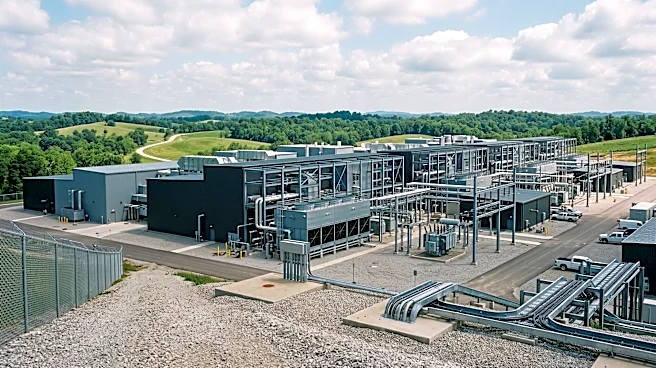
TeraWulf CEO Paul Prager announced that the company is not rushing to secure a tenant for its Muskie data center campus in Kentucky. This decision is driven by a commitment to protect shareholders from dilution, even as U.S. markets experience a significant
sell-off, which Prager described as a 'terrible market.' Despite the challenging market conditions and altered risk appetite, the demand for compute power and the scarcity of supporting infrastructure remain unchanged. TeraWulf had previously doubled the contracted power at Muskie to 1 GW in October. Prager emphasized the importance of finding the right customer with strong credit, favorable economics, and a deal structure that allows TeraWulf to fund its equity share without resorting to dilution. He noted that several interested parties are still engaging with the company regarding the gigawatt-scale site.
Why It's Important?
This strategic stance by TeraWulf's CEO highlights a broader trend in the data center and technology sectors, where long-term value and shareholder protection are being prioritized over short-term gains, especially in volatile market conditions. The emphasis on securing the 'right' customer, rather than just any customer, reflects a mature approach to asset management and risk mitigation. For the U.S. technology infrastructure landscape, this indicates that companies with established power, permits, and infrastructure, like TeraWulf, are becoming increasingly valuable. The market's current state, characterized by a sell-off, is forcing a differentiation between speculative projects and those with tangible assets and strong fundamentals. This could lead to a more robust and sustainable growth trajectory for the data center industry, as only well-positioned and financially sound projects attract significant investment and partnerships.
What's Next?
TeraWulf will continue its efforts to identify a suitable tenant for the Muskie data center campus, focusing on partners who can offer prepayments, customer-funded equipment, or strategic capital to provide the necessary equity. This approach aims to avoid shareholder dilution while securing a long-term, beneficial partnership. The company anticipates that the current market environment, despite its challenges, presents an opportunity to strengthen its competitive position by attracting customers who recognize the value of its established infrastructure. The recent Blackstone-Amazon data center deal, which Prager cited as a valuable benchmark, suggests that long-term investors are willing to pay a premium for consistent data center cash flows backed by strong credit, potentially influencing future negotiations and deal structures for TeraWulf.
Beyond the Headlines
The CEO's comments underscore a critical shift in investment philosophy within the tech infrastructure sector. In a 'terrible market,' the focus moves from rapid expansion at any cost to strategic, value-driven growth. This could lead to a consolidation of power and resources among companies that possess existing, well-developed infrastructure, creating a 'moat' against newer, less established players. The increased scrutiny on creditworthiness and deal economics also reflects a more cautious capital allocation environment, where investors are demanding clearer returns and less risk. This could have long-term implications for the financing and development of large-scale data center projects, potentially favoring companies with strong balance sheets and proven operational capabilities. The emphasis on avoiding dilution also signals a growing concern for shareholder value in a market where public valuations have been under pressure.