





What's Happening?
BYD, a prominent global company, has achieved its competitive standing through a strategic approach focused on disciplined sequential learning and vertical integration, rather than solely pursuing disruptive innovation or 'moonshots.' The company has spent
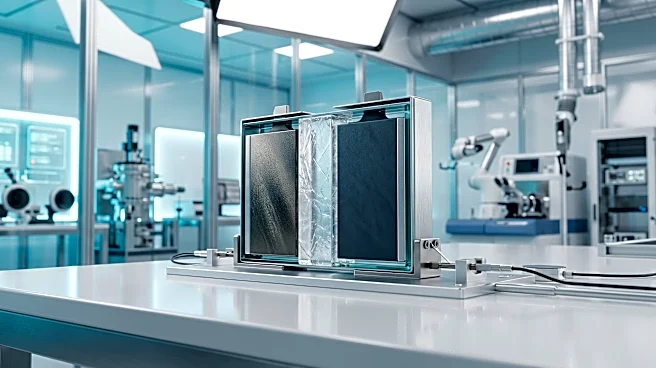
approximately 15 years systematically building capabilities, with each step reinforcing the last. This method has allowed BYD to develop unique competencies that differentiate it from competitors. For instance, BYD reimagined battery structure by developing the 'Blade Battery,' which enhances safety and efficiency. The company's Shenshan site, spanning 3.79 million square meters, is not merely an assembly plant but a vertically integrated operation where BYD casts its own motors, laminates battery cells, prints circuit boards, and designs its own IGBT and SiC chips through BYD Semiconductor.
Why It's Important?
BYD's strategic emphasis on sequential capability building and vertical integration offers a compelling model for competitive strategy in rapidly evolving industries. This approach provides significant advantages, including enhanced resilience against supply chain disruptions and increased speed during technological transitions. By controlling key components and manufacturing processes in-house, BYD can maintain greater quality control, reduce costs, and accelerate product development cycles. This strategy has enabled BYD to challenge established players in the automotive sector, particularly in electric vehicles, by offering innovative solutions in areas like battery technology and vehicle performance. The success of this model suggests that a methodical, step-by-step accumulation of capabilities can be more effective than solely relying on dramatic technological leaps, especially in complex manufacturing environments.
What's Next?
BYD is expected to continue leveraging its vertically integrated structure and sequential innovation strategy to push the boundaries of vehicle capabilities. The company is actively challenging conventional limitations in areas such as battery safety (solving thermal runaway), off-roading (floating SUVs), infotainment (integrated drones), and chassis control (jumping and crab-walking). This ongoing commitment to expanding what vehicles can do, rather than merely optimizing existing solutions, indicates a future where BYD will likely introduce more advanced and unconventional features in its product lineup. The company's continuous investment in its own semiconductor division also suggests a long-term vision for self-sufficiency and technological leadership in critical components, further solidifying its competitive position.
Beyond the Headlines
The 'tortoise and the hare' analogy aptly describes BYD's competitive strategy, highlighting that consistent, methodical execution can outperform rapid, but potentially unsustainable, sprints. This approach has allowed BYD to build a robust foundation of capabilities that its competitors often lack. The company's focus on mastering fundamental, often 'unglamorous,' details, such as battery structure and internal component manufacturing, has created significant competitive bulwarks. This deep-seated expertise enables BYD to innovate from a position of strength, transforming its accumulated knowledge into groundbreaking products and features. The ethical implications of such extensive vertical integration include potential concerns about market dominance and the impact on smaller suppliers, though it also offers benefits in terms of quality control and supply chain stability.