
What's Happening?
The expansion of the Delaware Container Terminal (DCT) at the Port of Wilmington has officially commenced, marking a significant public-private partnership between Enstructure and the State of Delaware,
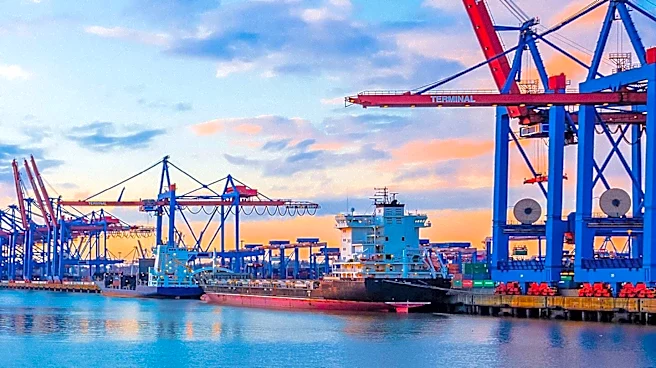
through the Diamond State Port Corporation (DSPC). This project, located on the former Edgemoor industrial site, aims to substantially increase Delaware's container handling capacity and strengthen supply chains across the region. The expansion is projected to create thousands of local jobs in the maritime, construction, supply chain, and logistics sectors. U.S. Senator Lisa Blunt Rochester highlighted that the expansion will incorporate cleaner energy practices, made possible by the Clean Ports Program, which she championed alongside former U.S. Senator Tom Carper. The DCT is designed to become a premier terminal for U.S. markets and the Northeast corridor, capable of handling up to 1.2 million TEUs (twenty-foot equivalent units) annually with a 2,700-foot wharf and a 45-foot depth, accommodating container ships up to 16,000 TEU capacity. The project represents a total investment of $669 million, with contributions from Enstructure, the State of Delaware, and federal grants from the Department of Transportation and the Environmental Protection Agency.
Why It's Important?
This expansion is crucial for enhancing the economic vitality of Delaware and the broader Northeast region. By significantly increasing container handling capacity, the DCT will improve access to regional, national, and international supply chains, doubling the port's capacity along the Delaware River. This strategic location, with proximity to major metropolitan areas like Philadelphia, Baltimore, Washington D.C., and New York, will offer an accessible and efficient gateway for global shipping, particularly in a less congested part of the region. The project's focus on cleaner energy practices, supported by the Clean Ports Program, signifies a commitment to environmental sustainability, aiming to reduce diesel exhaust, greenhouse gas emissions, and noise pollution. This not only benefits the environment but also improves air quality for port workers and neighboring communities. The creation of thousands of well-paying, unionized jobs will provide substantial economic opportunities for Delaware families and contribute to the state's long-term economic growth and competitiveness in the maritime industry.
What's Next?
The Delaware Container Terminal is expected to be completed by 2029, at which point Enstructure will operate the facility under a long-term concession agreement. The project will continue to engage with local communities and stakeholders, as Enstructure and DSPC have already participated in over 30 community meetings and site visits. Ongoing efforts will include monitoring environmental performance, collecting and analyzing operational data to measure results, and improving implementation over time, supported by the Clean Ports Program funding. The terminal will integrate advanced technologies and low-emission operating practices, including electric cargo handling equipment and charging infrastructure. The project will also maintain an emissions inventory and adhere to applicable air and water quality requirements, waste management, and environmental monitoring. These steps aim to ensure the terminal fosters shared prosperity and delivers lasting benefits for future generations while positioning Wilmington as a leading port on the global stage.
Beyond the Headlines
The Delaware Container Terminal expansion represents more than just an infrastructure project; it embodies a forward-thinking approach to economic development that integrates environmental responsibility and community engagement. The emphasis on the Clean Ports Program and the use of electric equipment sets a precedent for sustainable port operations, potentially influencing future port developments across the U.S. This public-private partnership model, combining significant investments from both state and private entities with federal grants, highlights a collaborative strategy to address critical infrastructure needs. The project's commitment to creating unionized jobs and engaging with local organizations underscores a broader societal impact, aiming to ensure that economic growth is inclusive and benefits a wide range of stakeholders. This initiative could serve as a blueprint for other regions seeking to modernize their infrastructure while simultaneously promoting environmental stewardship and local economic empowerment.