
What's Happening?
Montclair-based urban explorer and author Wheeler Antabanez has released his new book, 'WHEELEROIDZ – Polaroids from North Jersey Vol. 2.' The photo collection, shot entirely with a Polaroid Now camera,
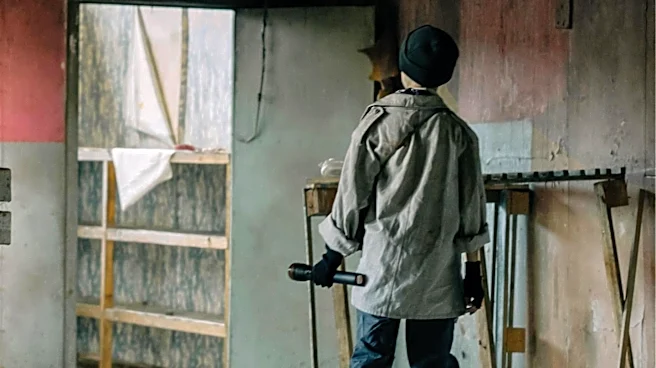
documents various abandoned locations across North Jersey, with a significant focus on Essex County. Featured sites include the largely vacant Livingston Mall, the former Orange Memorial Hospital which closed in 2005, and the abandoned Proctor’s Palace Theatre on Market Street in downtown Newark. Other Newark locations like Borden’s Creamery/Peddler’s Village and the Genesis Towers/Dog Towers are also included. Antabanez, known for his dark exploits, claims to have experienced a ghost sighting at Orange Memorial Hospital, which challenged his previous skepticism about the supernatural. The book, published by Antabanez’s imprint Abandoned Books, features over 100 black-and-white Polaroids, each with a two-line caption providing context.
Why It's Important?
Wheeler Antabanez's 'WHEELEROIDZ Vol. 2' offers a unique cultural and historical documentation of decaying urban and suburban landscapes in Essex County, New Jersey. This work is important for several reasons: it preserves the visual memory of places that are often overlooked or forgotten, providing a historical record of architectural and social change. The use of Polaroid photography adds a nostalgic and raw aesthetic, emphasizing the transient nature of these sites. For local communities, the book can evoke a sense of reflection on urban development, economic shifts, and the passage of time. It also taps into the growing interest in urban exploration and the allure of abandoned spaces, which can spark conversations about preservation, redevelopment, and the stories embedded within these structures. Antabanez's personal experience with a ghost sighting adds a layer of intrigue, blending objective documentation with subjective, potentially supernatural encounters, which can appeal to a broader audience interested in local folklore and mystery.
What's Next?
The release of 'WHEELEROIDZ – Polaroids from North Jersey Vol. 2' will likely continue to generate interest among urban exploration enthusiasts, local historians, and photography aficionados. Antabanez may engage in book signings, lectures, or exhibitions to share his experiences and the stories behind the abandoned locations. The book could also inspire other photographers and explorers to document similar sites in their own regions, contributing to a broader movement of preserving visual histories of forgotten places. Discussions might arise within Essex County communities about the future of these abandoned structures, prompting conversations about potential redevelopment, historical preservation, or even demolition. The book's content, particularly the inclusion of a professional skateboarder discovering a historic skate spot, could also attract niche communities interested in the intersection of urban exploration and subcultures.
Beyond the Headlines
Antabanez's exploration of abandoned spaces in Essex County delves into deeper societal implications beyond mere visual documentation. These decaying structures often symbolize economic decline, shifts in industry, and the changing fabric of American communities. The Livingston Mall, for instance, represents the challenges faced by traditional retail in the age of e-commerce, while the Orange Memorial Hospital speaks to transformations in healthcare and urban planning. The act of documenting these sites through photography can be seen as a form of archaeological preservation, capturing the remnants of past eras before they are completely erased. Furthermore, the allure of abandoned places often stems from a fascination with the unknown, the passage of time, and the stories these silent structures hold. Antabanez's personal encounter with a 'ghost' at Orange Memorial Hospital adds a psychological dimension, highlighting how such environments can evoke powerful emotional and even spiritual responses, blurring the lines between the tangible and the intangible. This work encourages viewers to contemplate the impermanence of human endeavors and the persistent echoes of history within our built environment.