





What's Happening?
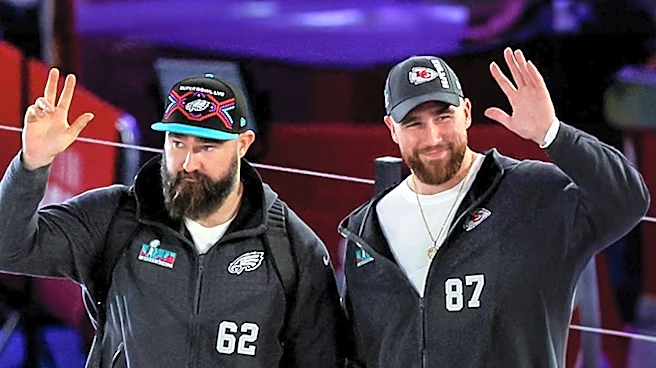
On a recent episode of the 'New Heights' podcast, Jason Kelce expressed a critical view of paternity leave, particularly regarding his social media director, Jake Chatzky, who was taking a month off. Jason argued that there is limited involvement for
fathers during an infant's early stages, stating that babies primarily 'eat, sleep, and shit.' He contrasted this with maternity leave, acknowledging its necessity, but questioned the extent of a father's practical contribution. His co-host and brother, Travis Kelce, disagreed, emphasizing the importance of taking time off when needed. When asked for her perspective, Jason's wife, Kylie Kelce, surprisingly agreed that three months for paternity leave was 'too long,' noting that her husband returned to work the day after their child's birth. These comments have since generated significant public criticism across social media platforms.
Why It's Important?
Jason Kelce's remarks on paternity leave highlight a broader societal debate regarding parental roles and the value of fathers' involvement in early childcare. His comments, particularly the suggestion that fathers have limited utility during an infant's first months, could reinforce traditional gender roles and undermine efforts to promote shared parenting responsibilities. This perspective might also influence workplace policies and cultural norms around parental leave, potentially discouraging fathers from taking time off or leading to less comprehensive paternity leave benefits. The backlash indicates a growing public expectation for fathers to be actively involved in childcare from birth, challenging outdated views on parental leave and its importance for family well-being and gender equality in the workplace. The discussion also touches upon the practical challenges faced by professional athletes, like Jason, who often have limited flexibility for parental leave due to demanding schedules.
What's Next?
The ongoing public discussion surrounding Jason Kelce's comments is likely to continue, potentially prompting further dialogue on the 'New Heights' podcast or other public platforms. This could lead to a more nuanced exploration of paternity leave benefits, the evolving roles of fathers in childcare, and the challenges faced by working parents, especially those in high-profile careers. The controversy may also encourage companies and organizations to re-evaluate their parental leave policies and communication strategies to ensure they align with contemporary societal values and support both mothers and fathers. It could also spark more personal reflections from other public figures on their experiences with parental leave, contributing to a broader cultural shift in how paternity leave is perceived and utilized.
Beyond the Headlines
The debate sparked by Jason Kelce's comments extends beyond individual opinions to touch upon fundamental societal structures and expectations regarding gender, work, and family. The idea that a father's role is minimal during infancy can perpetuate a cycle where mothers disproportionately bear the burden of early childcare, impacting their career progression and overall well-being. Conversely, robust paternity leave policies are increasingly seen as crucial for promoting gender equality, allowing mothers to return to work sooner, and fostering stronger family bonds. The discussion also highlights the tension between traditional expectations of masculinity, which often prioritize work over family, and modern calls for more engaged fatherhood. This incident serves as a cultural touchstone, reflecting ongoing shifts in how society views and values the contributions of both parents in raising children.