





What's Happening?
Mizuho has initiated coverage of Rocket Lab (RKLB) with an Underperform rating and a price target of $40, suggesting a 14% downside from its closing price of $46.65 on November 24. This assessment comes after Rocket Lab's stock has already fallen 69%
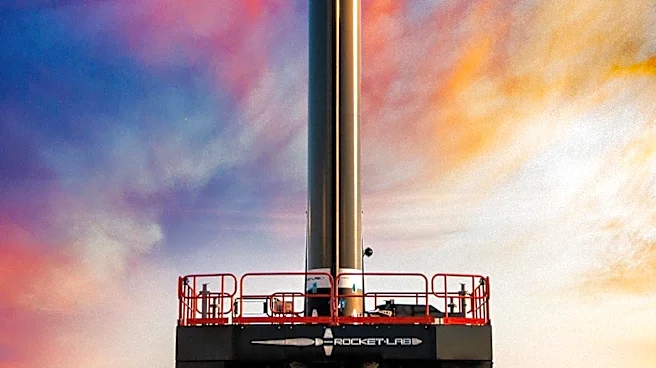
from its May high. The firm's analysis indicates that even at $40, the stock would trade at approximately 167 times the normalized earnings analysts expect for 2028, an estimate that continues to decline. Recent developments include Rocket Lab pushing the first launch of its Neutron rocket into 2027 due to issues with a first-stage tank dome, as confirmed by CEO Peter Beck. While a replacement dome has been made, no new launch date has been provided. The company reported record revenue of $268 million in the third quarter, a 73% year-over-year increase, and a $3.57 billion backlog. However, the GAAP loss widened to $0.12 per share from $0.08 in the second quarter, largely due to one-time costs associated with the Iridium deal. Rocket Lab also sold $2.4 billion in stock during the quarter to finance the Iridium acquisition, and CFO Adam Spice anticipates negative free cash flow to remain elevated as Neutron development continues.
Why It's Important?
Mizuho's Underperform rating and price target for Rocket Lab highlight significant concerns regarding the company's valuation and future profitability, which could influence investor sentiment and stock performance in the U.S. market. The projected 14% downside, coupled with the already substantial drop from its May high, suggests a challenging outlook for current and prospective shareholders. The delay of the Neutron rocket's first launch into 2027 is a critical factor, as the success and timely deployment of this new launch vehicle are central to Rocket Lab's long-term growth strategy and market position in the competitive space industry. The widening GAAP loss and continued negative free cash flow, despite record revenue and a substantial backlog, indicate that the company's expansion and acquisition activities are heavily impacting its financial health in the short to medium term. This situation could deter investors seeking immediate returns and pressure the company to demonstrate a clearer path to profitability and operational efficiency.
What's Next?
The immediate next steps for Rocket Lab involve providing a new launch date for its Neutron rocket, which CEO Peter Beck has indicated is contingent on the replacement dome. The company's fourth-quarter results, expected in early 2027, will also be a critical test, particularly regarding whether revenue meets or exceeds the guided range of $270-$290 million. For Iridium Communications shareholders, who are being paid partly in Rocket Lab stock as part of the acquisition, the Federal Communications Commission's (FCC) consent is a key milestone to watch before the targeted mid-2027 deal close. Analysts' consensus price targets for Rocket Lab have already seen significant reductions, with the average falling from nearly $117 in mid-July to $91. Further adjustments may occur depending on these upcoming developments and the company's ability to address profitability concerns and launch delays. The market will be closely watching for signs that earnings estimates stabilize or improve, as this is crucial for the stock to potentially earn its current valuation.
Beyond the Headlines
The situation with Rocket Lab extends beyond immediate financial metrics, touching upon the broader dynamics of the commercial space industry and the challenges of scaling innovative technologies. The delay of the Neutron rocket underscores the inherent complexities and risks associated with developing advanced aerospace hardware, where unforeseen technical issues can significantly impact timelines and financial projections. This scenario highlights the tension between ambitious growth strategies, such as the acquisition of Iridium, and the operational realities of bringing new products to market. The reliance on stock sales to fund acquisitions and ongoing development also points to the capital-intensive nature of the space sector, where companies often require substantial investment before achieving consistent profitability. Furthermore, the competitive landscape, particularly with players like SpaceX, influences pricing strategies and market share, as evidenced by the reported uplift in Electron pricing after SpaceX's changes to Falcon 9 rideshare bookings. This suggests that Rocket Lab's long-term success will depend not only on its technological advancements but also on its ability to navigate a rapidly evolving and highly competitive market.