




The Old Cosmic Recipe
For decades, the prevailing wisdom in astrochemistry has been a 'bottom-up' approach to building complex molecules in space. The theory was that in the frigid, near-vacuum of a molecular cloud, simple atoms like carbon would painstakingly link up one
by one, forming ever-longer chains and more intricate structures over millions of years. This slow-and-steady growth was thought to be the only way to create the carbon-rich compounds—from ringed molecules called polycyclic aromatic hydrocarbons (PAHs) to other organic precursors—that are considered essential for life. Scientists have found many of these molecules, but the assumption was always that bigger molecules must come from smaller ones in a linear, additive process. It made sense; in such a sparse environment, complex collisions seemed too improbable. The universe, it was thought, built its most interesting ingredients with patience.
A Sweet and Puzzling Find
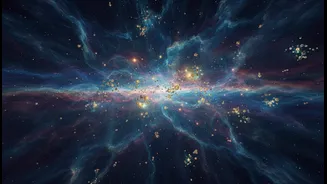
That neat and tidy theory has just been shaken by a discovery made in a gas cloud near the center of our Milky Way. An international team of astronomers, using powerful radio telescopes in Spain, detected something that had never been seen before in interstellar space: a true sugar. The molecule, called erythrulose, is a four-carbon sugar—a monosaccharide also found on Earth in things like raspberries. While sugar-adjacent molecules had been found before, this was the first time a genuine, multi-carbon sugar was identified floating freely in the birthplace of stars. But it wasn't just its presence that was shocking. The true puzzle was its abundance. According to the bottom-up theory, there should have been plenty of three-carbon sugars around, which would serve as the stepping stone to the four-carbon erythrulose. But the astronomers found the opposite: erythrulose was at least eight times more common than its smaller three-carbon cousins, which weren't detected at all. The recipe was clearly wrong.
A New Way to Build
This surprising lack of smaller sugars suggests that erythrulose isn't being built one carbon atom at a time. Instead, the research team proposes a far more efficient pathway. The evidence suggests that the four-carbon sugar forms when two smaller, two-carbon molecules (like glycolaldehyde) meet and combine on the surface of icy dust grains. These grains act like tiny, frozen workbenches, concentrating the ingredients and providing a stable surface for them to react. Rather than a slow, linear assembly line, the universe appears to be using a modular approach, snapping together pre-built chunks to create more complex structures. This finding completely changes the perspective on interstellar chemistry, suggesting it could be faster, more efficient, and capable of producing larger molecules more readily than previously imagined.
Why This Cosmic Sugar Matters
The discovery of erythrulose in a molecular cloud is more than just a chemical curiosity; it has profound implications for the origins of life. Sugars are fundamental to biology as we know it, forming the backbone of RNA and DNA and serving as an energy source for cells. The fact that a true sugar can form in space before stars and planets even exist provides the strongest evidence yet for the theory of panspermia—the idea that life's essential ingredients were not created on Earth, but delivered here. For billions of years, comets and asteroids, which are leftovers from the formation of the solar system, have bombarded our planet. If these objects formed from interstellar clouds already seeded with complex sugars, they could have delivered tonnes of these vital, ready-made ingredients to the primordial Earth, giving life a crucial head start. It changes the question from 'How did life's building blocks form on Earth?' to 'What was already available from the cosmos?'.