





What's Happening?
Disney has officially announced the release dates for the next two installments in James Cameron's 'Avatar' franchise. 'Avatar 4' is slated to premiere on December 21, 2029, and 'Avatar 5' will follow on December 19, 2031. This confirmation comes after
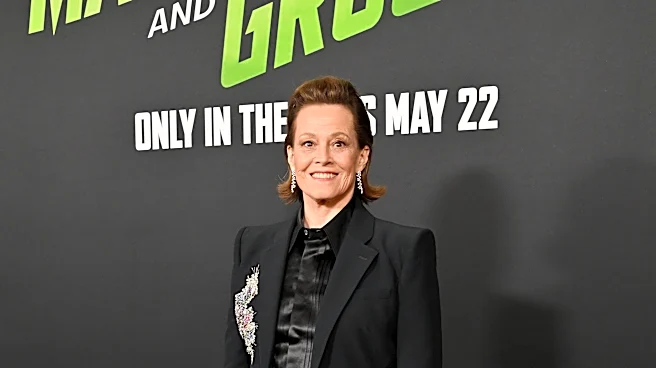
the third film, 'Avatar: Fire and Ash,' grossed $1.48 billion worldwide, which, while substantial, was considered 'barely profitable' due to its reported $500 million budget. Director James Cameron has previously voiced concerns regarding the high production costs and the time commitment involved in creating each film, leading to questions about the franchise's long-term viability. Notably, some scenes for 'Avatar 4' have already been filmed concurrently with previous installments to account for a six-year time jump in the narrative, particularly involving the younger members of the Sully family. The core cast, including Sam Worthington as Jake Sully, Zoe Saldaña as Neytiri, Sigourney Weaver as Kiri, and Stephen Lang as Miles Quaritch, is expected to return.
Why It's Important?
The confirmation of 'Avatar 4' and 'Avatar 5' release dates by Disney is significant for the entertainment industry, particularly for the future of major cinematic franchises. The financial performance of 'Avatar: Fire and Ash,' which, despite a massive global box office, was deemed 'barely profitable,' highlights the escalating costs associated with blockbuster productions. This situation could influence how studios approach funding and greenlighting future high-budget films, potentially leading to more stringent financial oversight or a shift towards more cost-effective production models. For Disney, the 'Avatar' franchise represents a substantial investment and a key component of its theatrical release strategy. The success or struggle of these upcoming films will provide crucial insights into the sustainability of mega-franchises in an evolving cinematic landscape, impacting investor confidence and future content development decisions across the industry. It also underscores the challenges even established directors like James Cameron face in balancing artistic vision with commercial viability.
What's Next?
With the release dates set, the focus will now shift to the production and marketing phases for 'Avatar 4' and 'Avatar 5.' James Cameron and his team will continue the extensive post-production work and potentially further principal photography, especially given the time jump planned for 'Avatar 4.' The financial performance of 'Avatar: Fire and Ash' will likely lead to increased scrutiny on the budgets and projected returns for the subsequent films. Disney will need to strategize its marketing campaigns to ensure these films achieve the necessary box office success to justify their immense production costs and secure the franchise's future. The industry will be closely watching to see if the 'Avatar' series can regain the overwhelming profitability seen with its earlier installments, which could dictate the scale and ambition of similar large-scale cinematic projects in the coming decade.
Beyond the Headlines
The 'Avatar' franchise's financial tightrope walk, where a $1.48 billion gross is considered 'barely profitable,' reveals a deeper trend in Hollywood: the increasing cost of spectacle. This situation raises questions about the long-term economic model for tentpole films, particularly those heavily reliant on groundbreaking visual effects and extensive world-building. It suggests that even with massive global appeal, the return on investment for such productions is becoming increasingly precarious. This could lead to a re-evaluation of production methodologies, a greater emphasis on international co-productions to share financial burdens, or a shift towards more contained, yet still impactful, storytelling. The ethical implications of such vast resource allocation for entertainment, especially when juxtaposed with global challenges, might also become a more prominent discussion point. Furthermore, James Cameron's expressed interest in pursuing other projects outside 'Avatar' hints at the personal toll and creative constraints that such long-term, high-stakes commitments can place on filmmakers, potentially influencing future directorial career paths in the industry.