





What's Happening?
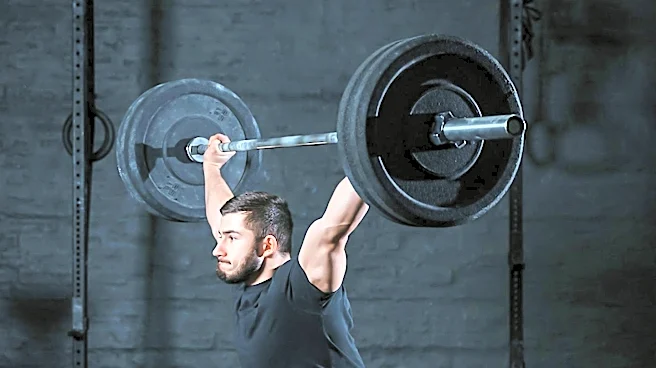
An exercise expert recommends overhead squats as a highly effective exercise for building full-body mobility and core control, suitable for individuals of all ages. This exercise, often associated with strength training in CrossFit, is highlighted for its
significant benefits in improving movement and control through the thoracic spine, enhancing balance and stability, increasing lower-body strength, and engaging the upper body. The technique involves standing with feet hip- or shoulder-width apart, extending arms overhead with shoulders pulled back, engaging the core, and lowering into a squat while maintaining a straight back and upright chest. The focus is on using a full range of motion, potentially holding light weights or a yoga block, rather than heavy loads, to prioritize mobility and proper form. The exercise helps reinforce correct squat technique, including shoulder position and foot placement.
Why It's Important?
This emphasis on mobility training, particularly through exercises like the overhead squat, is crucial for long-term physical health and functional independence. As individuals age, typically starting in their mid-thirties, there's a natural decline in muscle mass, bone density, and joint flexibility. Incorporating exercises that improve range of motion, balance, and stability can mitigate these age-related declines, reducing the risk of falls and injuries. For the general population, better mobility translates to easier execution of daily activities and a higher quality of life. For athletes or those engaged in regular physical activity, enhanced mobility can improve performance and prevent injuries by ensuring proper biomechanics and joint health. The focus on core control and full-body engagement also contributes to overall structural integrity and efficient movement patterns.
What's Next?
Individuals interested in improving their mobility and core strength can begin incorporating overhead squats into their fitness routines. It is advised to start with bodyweight or light props, focusing on mastering the form before considering any added weight. Consistency in practice, with 3-4 sets of 6-10 repetitions, is key to seeing improvements. Those new to the exercise or experiencing pain should consult a medical professional or a certified fitness trainer to ensure proper technique and avoid injury. Over time, practitioners can expect to notice a stronger core and lower body, increased range of motion in the hips, knees, and ankles, and a more stable upper body capable of safely supporting weight overhead. Continued integration of such mobility-focused exercises will contribute to sustained physical well-being.
Beyond the Headlines
The recommendation of overhead squats for mobility underscores a broader shift in fitness philosophy towards longevity-focused training. This approach prioritizes functional strength, balance, and stability over purely aesthetic or maximal strength goals, recognizing the importance of maintaining physical capabilities throughout life. The integration of mind-body connection and precise movement control, as seen in exercises like the overhead squat, highlights a holistic view of fitness that extends beyond muscle building to encompass joint health, proprioception, and injury prevention. This trend reflects a growing awareness of how daily movement patterns and long-term physical resilience are interconnected, encouraging individuals to adopt exercise regimens that support a more active and independent lifestyle well into their later years.