






What's Happening?
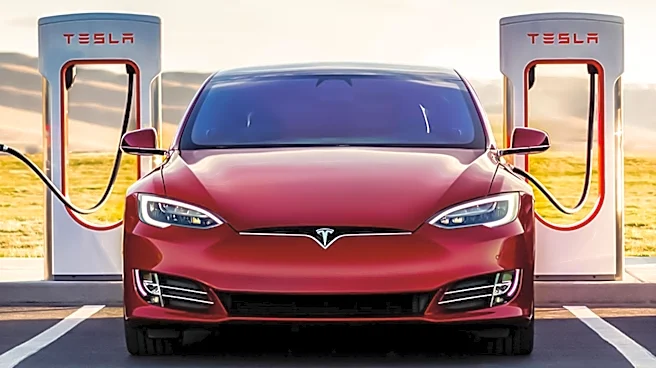
Tesla experienced a third consecutive year-on-year decline in its China retail sales in August, with 50,047 vehicles sold, marking a 12.43% decrease compared to the previous year. This figure, provided by the China Passenger Car Association (CPCA), represents
Tesla's weakest August for China retail sales since 2022. Despite the year-on-year drop, sales did see an 83.67% increase month-on-month from July. For the first eight months of the year, Tesla's cumulative China retail sales totaled 316,251 vehicles, a 12.44% decrease year-on-year. The company also underperformed the broader battery electric vehicle (BEV) market in China, which saw a 1% year-on-year growth in August, with Tesla holding a 7.17% market share, down from 8.33% a year prior. In contrast to the domestic retail slump, exports from Tesla's Shanghai factory surged by 38.71% in August, with cumulative exports for the year exceeding domestic retail sales.
Why It's Important?
This sustained decline in Tesla's China retail sales highlights increasing competition and potential shifts in consumer preferences within the world's largest electric vehicle market. China is a critical market for global automotive manufacturers, and a prolonged downturn in domestic sales for Tesla could impact its overall revenue and market valuation. The reliance on exports from the Shanghai factory to offset domestic retail weaknesses indicates a strategic pivot or a challenge in local market penetration. This trend could signal a broader struggle for foreign EV brands to maintain dominance against rapidly growing domestic Chinese EV manufacturers. For U.S. investors, this data provides insight into Tesla's performance in a key international market, potentially influencing stock performance and future investment decisions. The underperformance against the overall Chinese BEV market suggests that Tesla is losing ground to competitors, which could prompt a re-evaluation of its market strategy in China.
What's Next?
In response to the domestic sales pressure, Tesla has already introduced cash incentives for the final weeks of the third quarter in China. Customers purchasing and taking delivery of inventory Model Y vehicles by September 30 can receive a 10,000 yuan ($1,475) reduction, while Model 3 vehicles offer a 5,000 yuan discount. These promotions, along with other benefits like paint options, insurance subsidies, and financing plans, aim to stimulate sales and clear inventory. The effectiveness of these incentives will be closely watched as Tesla attempts to reverse the declining trend in its China retail market. Future reports on sales figures will indicate whether these measures have successfully boosted domestic demand or if further strategic adjustments, such as new model introductions or pricing changes, will be necessary to regain market share in China.
Beyond the Headlines
The divergence between Tesla's declining domestic retail sales and increasing exports from its Shanghai factory points to a complex dynamic in its global strategy. While the Shanghai plant serves as a crucial export hub, the struggle to maintain domestic sales growth in China suggests deeper challenges related to brand perception, local competition, or evolving consumer demands. This situation could lead to a re-evaluation of Tesla's manufacturing and distribution strategies, potentially shifting more focus towards export markets or intensifying efforts to localize its offerings and marketing in China. The trend also underscores the growing maturity and competitiveness of the Chinese EV market, where local players are rapidly innovating and capturing market share. This could set a precedent for other foreign automotive companies operating in China, emphasizing the need for agile and localized strategies to succeed in this dynamic environment.