






What's Happening?
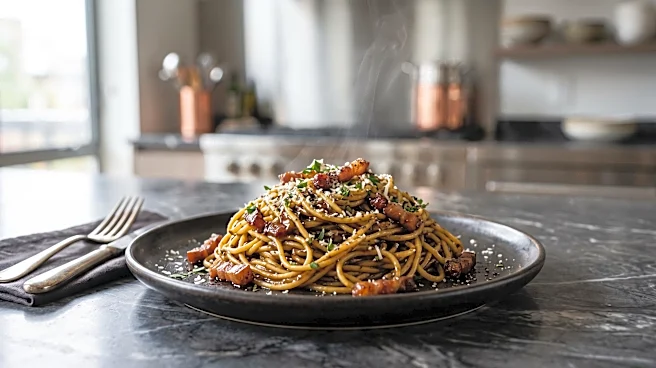
Brooklyn Beckham's recent cooking video, featuring a pasta dish, has once again drawn significant online mockery. A Threads user compared his latest creation to 'hospital cafeteria food,' despite Beckham's purported use of expensive ingredients and Michelin-star
techniques. The post, shared by the account lightandgravity, highlighted a plate of spaghetti topped with dark-colored pieces, prompting jokes and questions from viewers about the ingredients and overall presentation. Commenters speculated on the dark pieces, with suggestions ranging from raisins to guanciale, and some even questioning if it was 'poo.' This incident follows a pattern of criticism Beckham has received for his cooking content, including a previous toad-in-the-hole tutorial that was mocked for its excessive caramelized onions. Another video from July 2025, promoting his Cloud23 hot sauce, also attracted attention when he appeared to collect seawater for cooking spaghetti, leading to questions about its safety. Despite the recurring negative reactions, Beckham has stated that such comments do not deter him, emphasizing that cooking brings him happiness.
Why It's Important?
The ongoing public scrutiny of Brooklyn Beckham's cooking videos highlights a broader cultural phenomenon where celebrity endeavors, particularly in accessible fields like cooking, are subjected to intense public judgment. This situation underscores the double-edged sword of social media for public figures: while it offers a direct platform for content creation and personal branding, it also exposes them to immediate and often harsh criticism. For brands associated with Beckham, such as his Cloud23 hot sauce, the ridicule could lead to mixed public perception, potentially affecting consumer trust or interest, despite the increased visibility. The debate also touches on the perceived authenticity and skill level expected from celebrities venturing into new domains, especially when their privileged background is contrasted with the perceived quality of their output. This dynamic can influence how other celebrities approach personal branding and content creation, potentially leading to more curated or less frequent personal posts to avoid similar backlashes.
What's Next?
It is likely that Brooklyn Beckham will continue to post cooking videos on his social media platforms, as he has previously stated that negative reactions do not deter him. This ongoing content creation will likely lead to further public commentary, both critical and supportive. The engagement, regardless of its nature, will continue to generate visibility for Beckham and any associated brands, such as his Cloud23 hot sauce. Future videos may prompt renewed discussions about the authenticity of his culinary skills, the cost of his ingredients versus the perceived outcome, and the role of celebrity in the culinary world. The online community will likely remain divided, with some defending his efforts to encourage home cooking and others continuing to mock his techniques and results. This cycle of creation, criticism, and defense is expected to persist as long as Beckham maintains his presence in the online cooking sphere.
Beyond the Headlines
The persistent mockery of Brooklyn Beckham's cooking videos delves into deeper societal discussions about privilege, authenticity, and the democratization of expertise in the digital age. Critics often highlight his privileged upbringing, suggesting a disconnect between his access to high-end ingredients and techniques and the perceived amateurish results. This narrative taps into broader resentments about inherited wealth and opportunities, contrasting it with the struggles of everyday individuals. Furthermore, the phenomenon raises questions about the nature of 'expertise' in the social media era, where passion and platform can sometimes overshadow formal training or demonstrable skill. The public's reaction also reflects a desire for authenticity and relatability from public figures, and when these expectations are not met, the response can be harsh. This ongoing saga serves as a case study in how celebrity status can amplify both positive and negative public sentiment, shaping perceptions far beyond the immediate content itself.