





What's Happening?
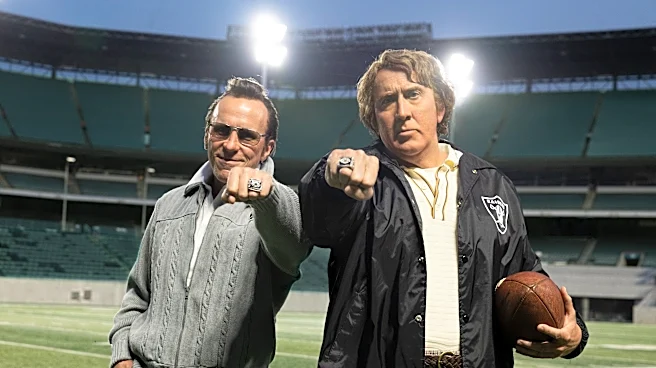
Actor Christian Bale recently disclosed that Tom Cruise served as an inspiration for his portrayal of Patrick Bateman in the 2000 cult classic 'American Psycho.' During an appearance on The Rich Eisen Show to promote his new film 'Madden,' Bale confirmed
that he kept pictures of Cruise in his trailer while preparing for the role. This influence stemmed from Bret Easton Ellis's novel, where Bateman is depicted as being somewhat obsessed with Cruise, who lives in the same building. Bale clarified that he did not specifically study Cruise's performances but rather embodied Bateman's perspective. Director Mary Harron had previously noted that Bale observed Cruise's public persona, particularly an intense friendliness that seemed to mask an emotional void, which helped shape Bateman's character. Bale also recounted finding the screenplay inherently humorous, often struggling to get through auditions without laughing due to the satirical nature of the character and story. He noted that not everyone involved in the production shared this view, leading to crew departures and protests during filming, as some failed to grasp the film's satirical intent.
Why It's Important?
This revelation offers significant insight into the creative process behind one of cinema's most iconic and complex characters, Patrick Bateman. Understanding the specific influences, such as Tom Cruise's public persona, helps audiences and film scholars further dissect Bale's performance and the film's broader commentary on consumerism, masculinity, and superficiality in the late 20th century. It underscores how actors draw from diverse sources, even unexpected ones, to build their characters. Furthermore, Bale's emphasis on the film's satirical nature is crucial. It reinforces the original intent of 'American Psycho' as a critique rather than an endorsement of Bateman's actions, a distinction often lost in contemporary internet meme culture, which sometimes glorifies the character. This clarification from the lead actor can help reframe public perception and encourage a deeper, more critical engagement with the film's themes, highlighting its enduring relevance as a social satire.
What's Next?
Christian Bale's latest film, 'Madden,' co-starring Nicolas Cage, is currently streaming on Prime Video. This new project will likely be the immediate focus for Bale's promotional activities. The discussion around 'American Psycho' and its influences may also reignite interest in potential future adaptations of Bret Easton Ellis's novel. While Luca Guadagnino had been developing a new adaptation, recent comments from the director suggest the project's future is uncertain, with Lionsgate not having officially canceled it but Guadagnino indicating it has slipped down his priority list. Bale's definitive portrayal of Bateman remains the benchmark, and any future attempts to adapt the story will inevitably be compared to his performance and the original film's satirical approach. The ongoing conversation about the film's satirical intent versus its reception in popular culture is also likely to continue, especially as new generations discover the movie.
Beyond the Headlines
The discussion surrounding Christian Bale's portrayal of Patrick Bateman and the film's satirical intent touches upon broader themes of artistic interpretation and audience reception. The fact that 'American Psycho' faced crew departures and protests during production due to its provocative material, and that its satirical message is still sometimes misunderstood today, highlights the challenges artists face in conveying complex social critiques. It underscores how audiences can sometimes misinterpret or selectively engage with media, particularly when dealing with dark humor or satire. The film's enduring presence in meme culture, often celebrating Bateman without acknowledging the underlying critique, raises questions about media literacy and the way narratives are consumed and recontextualized in the digital age. This phenomenon reflects a broader cultural trend where nuanced artistic messages can be flattened or distorted, prompting a re-evaluation of how satire functions and is understood in contemporary society.