





What's Happening?
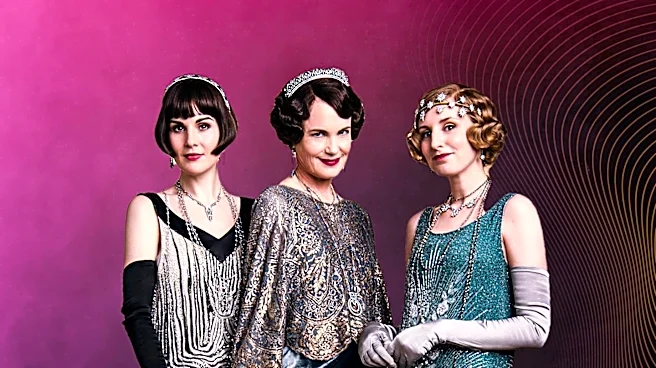
Downton Abbey, a British period drama created by Julian Fellowes, remains a prominent cultural touchstone. The series, which ran for six seasons, has been extended with three feature films, continuing the narrative of the Crawley family and their servants
at Downton Abbey in the early 20th century. The show's enduring popularity is highlighted by its high IMDb rating of 8.7 and its availability on BritBox. Recently, Downton Abbey has drawn comparisons to HBO's 'The Gilded Age,' another historical drama also created by Fellowes. While 'The Gilded Age' focuses on the rise of America's new elite in the 1880s, 'Downton Abbey' explores the decline of the British aristocracy, offering a parallel yet distinct look at societal shifts during different periods. Actors from the series, such as Hugh Bonneville, have also continued to appear in other projects, demonstrating their versatility beyond their roles in Downton Abbey.
Why It's Important?
The continued relevance of 'Downton Abbey' underscores the significant public interest in historical dramas that explore societal structures and class dynamics. The comparison with 'The Gilded Age' highlights a broader trend in television production, where creators like Julian Fellowes are able to translate successful narrative formulas across different historical and geographical contexts. This not only provides diverse content for viewers but also demonstrates the commercial viability of period pieces. For the entertainment industry, the success of 'Downton Abbey' and its subsequent films, along with the interest in related series, indicates a strong market for high-quality, character-driven historical narratives. This trend can influence investment in similar productions and the careers of actors associated with such acclaimed series, as evidenced by Hugh Bonneville's continued work. The show's high ratings and streaming availability also contribute to the ongoing competition among streaming platforms for exclusive and popular content.
What's Next?
Given the sustained interest in 'Downton Abbey' and the success of its feature films, it is plausible that further cinematic or television projects related to the series could be explored. The continued comparison with 'The Gilded Age' might also lead to increased cross-promotion or thematic discussions between the two series, potentially drawing new viewers to both. For actors like Hugh Bonneville, their continued involvement in diverse projects suggests a lasting impact of 'Downton Abbey' on their careers, potentially leading to more high-profile roles. The success of these period dramas could also encourage other creators and networks to invest in similar historical narratives, potentially leading to a new wave of period-specific content across various streaming platforms and television networks. The ongoing availability on platforms like BritBox ensures continued accessibility for existing fans and new audiences.
Beyond the Headlines
The enduring appeal of 'Downton Abbey' extends beyond mere entertainment, touching upon deeper cultural and historical fascinations. The series provides a window into the complexities of class, tradition, and social change in early 20th-century Britain, offering viewers a nuanced understanding of a bygone era. Its comparison to 'The Gilded Age' further emphasizes a global interest in periods of significant societal transformation and the challenges faced by different social strata. Ethically, these dramas often prompt reflection on issues of privilege, duty, and the human condition within specific historical constraints. Culturally, 'Downton Abbey' has become a benchmark for period drama, influencing fashion, interior design, and even tourism. The show's ability to resonate with a broad audience, despite its specific historical setting, speaks to universal themes of family, loyalty, and adaptation in the face of change, making it a significant cultural phenomenon.