






What's Happening?
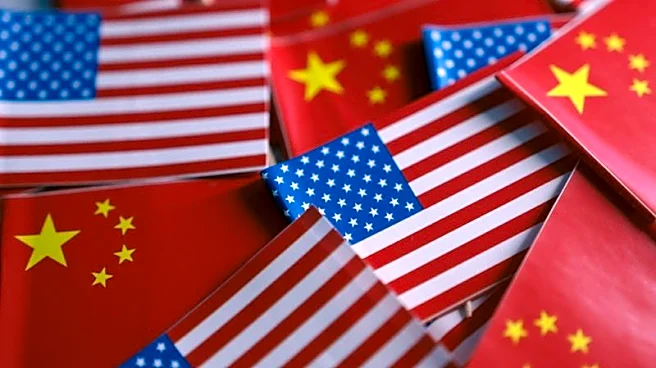
China is not seeking to dethrone the U.S. dollar as the world's dominant currency but rather aims for the yuan (renminbi) to become a strong second or third global currency, akin to Pepsi's position relative to Coca-Cola. According to Zongyuan Zoe Liu,
senior fellow for China studies at the Council on Foreign Relations, Beijing's primary motivation for promoting the yuan internationally is to mitigate the U.S.'s ability to weaponize the financial system through sanctions. China prefers to avoid the obligations of being the global reserve currency, which would require open capital markets that could threaten the Communist Party's control. Instead, China is building a yuan network to bypass dollar-based sanctions, focusing on facilitating renminbi use in trade, commodity markets, and financing, particularly in sectors where China has established dominance, such as critical minerals and green energy equipment.
Why It's Important?
This strategy has significant implications for the U.S. dollar's global dominance and the effectiveness of U.S. financial sanctions. If the yuan achieves a substantial international presence, even without becoming the primary reserve currency, it could reduce the U.S.'s unilateral power to impose financial penalties. This would offer countries an alternative payment and settlement system, potentially weakening the dollar's role as the sole global financial arbiter. For U.S. businesses and the broader economy, a more diversified global currency landscape could introduce new complexities in international trade and finance, potentially affecting exchange rates, investment flows, and the cost of capital. The development of a 'green yuan' tied to China's dominance in green supply chains could also shift economic power dynamics in emerging industries.
What's Next?
China will likely continue its efforts to expand the yuan's international use through various mechanisms, including promoting yuan benchmarks on commodity exchanges, increasing yuan lending to overseas borrowers, and forging more currency swap agreements with foreign central banks. The focus will remain on sectors where China has significant control, such as critical minerals and clean energy technologies, to establish yuan-denominated trade. However, the yuan's full potential is constrained by China's unpredictable capital controls, which deter foreign investors from holding substantial yuan assets. For the yuan to become a truly viable alternative, China would need to address these concerns and create a larger, more accessible pool of renminbi assets for foreigners to freely buy and sell.
Beyond the Headlines
The 'Pepsi to the dollar's Coca-Cola' analogy highlights a strategic shift in China's approach to global financial power, moving away from direct confrontation to a more nuanced strategy of creating viable alternatives. This could lead to a more multipolar global financial system, where no single currency holds absolute sway. Such a shift could have profound long-term effects on global governance, trade relationships, and geopolitical stability. It also underscores the increasing weaponization of finance in international relations, prompting nations to seek greater financial autonomy. The potential emergence of a 'green yuan' could also accelerate the global transition to green technologies, but under a financial framework increasingly influenced by China, raising questions about future economic dependencies and standards in the burgeoning green economy.