
What's Happening?
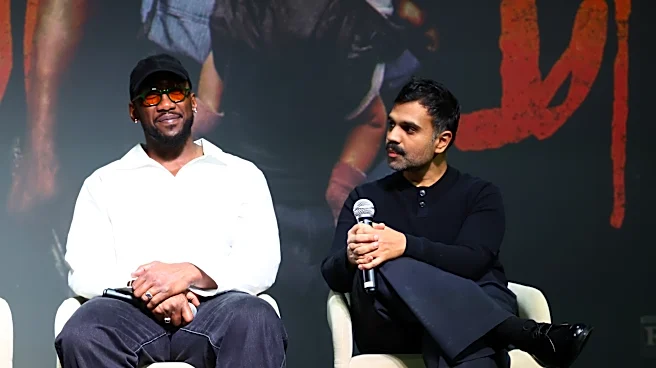
Director Bassam Tariq has openly discussed his experience working on Marvel's ultimately scrapped 'Blade' reboot, revealing that the project taught him the importance of creative control. In an interview
with The New Arab, Tariq stated that he found it 'dangerous' to begin casting and building a film without a complete and proper script. He emphasized his preference for having full control over his scripts, noting that a lack of a finalized script can undermine a director's credibility with actors if the final text doesn't align with initial discussions. Tariq had been attached to direct the 'Blade' film, with Mahershala Ali announced as the star. Tariq exited the project in September 2022, and Ali later confirmed in July that he would not be leading the film. Both Tariq and Ali have referred to the project's failure as a significant setback for Marvel Studios President Kevin Feige.
Why It's Important?
Tariq's comments shed light on the internal workings and potential challenges within large studio productions, particularly those involving major franchises like Marvel. His experience highlights a critical tension between creative vision and corporate decision-making, where directors may feel pressured to proceed without essential elements like a finalized script. This situation can impact the quality of the film, the morale of the cast and crew, and ultimately the financial success and critical reception of the project. The emphasis on creative control by a director like Tariq underscores a broader industry debate about artistic integrity versus commercial viability, especially in an era dominated by interconnected cinematic universes. The failure of a high-profile project like 'Blade,' despite having a two-time Oscar-winning actor attached, signals potential systemic issues within the production process that could affect future studio endeavors.
What's Next?
Following his departure from the 'Blade' project, Bassam Tariq is likely to prioritize projects where he can exert greater creative control, aligning with his stated lesson that 'life's too short to make sh** films.' This experience may influence his future collaborations and choices within the film industry, potentially leading him towards more independent productions or studios that offer more artistic freedom. For Marvel Studios, the 'Blade' project's difficulties, as acknowledged by both Tariq and Mahershala Ali, may prompt an internal reevaluation of their development and production processes, particularly concerning script finalization and director autonomy. The search for a new director and a clear creative direction for 'Blade' will continue, with the studio likely seeking to avoid similar pitfalls in future high-stakes productions.
Beyond the Headlines
Tariq's candid remarks touch upon the ethical dimensions of filmmaking, particularly the responsibility a director has to their actors and their own artistic integrity. The idea of losing credibility with actors due to corporate decisions or an incomplete script raises questions about the human element in large-scale productions. It also highlights the potential for creative burnout and disillusionment when artists feel their vision is compromised. This situation could contribute to a broader industry trend where established and respected filmmakers might become more selective about engaging with massive franchises, opting instead for projects that offer more creative fulfillment. The 'Blade' scenario serves as a case study for the ongoing tension between the industrial model of blockbuster filmmaking and the individual artistic aspirations of directors and actors.